Monday, August 14, 2006

My Life as a Tourist in China

I first went to China on a lark. In 1982 I was in Hong Kong with some time on my hands so I arranged a 3 day tour of Guangzhou. I made the trip on a ferry sailing up the Pearl river that was boarded by several nervous PLA sailors brandishing AK47s when we crossed into Chinese waters. I don’t much care for organized tours but when China first parted the bamboo curtain that tentative first crack after the death of Mao Zedong in 1976 Americans were only allowed in as part of tour groups. My second trip to China in 2005 was on another lark. I wanted to go somewhere exotic, but not so exotic that the language rendered me functionally illiterate or where I’d be confronted by a strange kind of toilet. I’m an American after all, I have my standards. Hong Kong was just what the doctor ordered. Although Hong Kong became the Hong Kong SAR (Special Administrative Region) in 1997 when the British handed it back the Chicoms in Beijing it has maintained many of its differences from the mainland under the “one country, two systems” policy. That means that unlike on the mainland cars in Hong Kong still drive on the left and have the steering wheel on the right British Empire style. Even though it isn’t widely spoken English is still one of the official languages in Hong Kong, which keeps occurrences of Chinglish down.

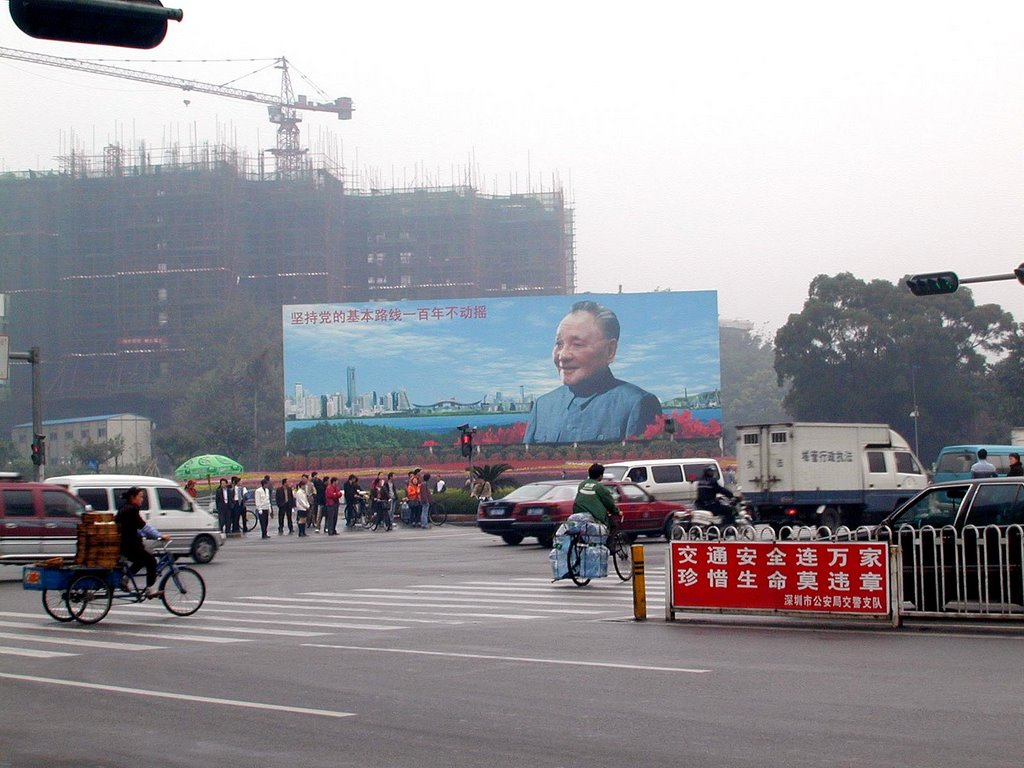
Hong Kong is a spectacular world city, for me it was China on training wheels. I enjoyed Hong Kong but I was restless to see what was on the other side of the border. Because even though the Hong Kong SAR is now part of the PRC proper the old pre-handover border remains. Hong Kong has its own customs and immigration services that are separate from those on the mainland. Getting to the border is as simple as boarding a KCRC commuter train and getting off at the last stop, Lo Wu. But I couldn’t cross the border without a visa. In another “one country, two systems” quirk American citizens need no visa to visit Hong Kong, just fly into the airport with a valid US passport and you’re in. But Americans do need a visa to cross the border from Hong Kong to the mainland, even to visit for just a few hours. Lots of inexpensive goods come from China but for American citizens a Chinese visa isn’t one of them. I arranged one through my hotel that cost me more than 800 Hong Kong dollars, that’s more than $100 US. But I wasn’t going to turn up my nose at a day trip to Guangdong province because of the cost. I wanted my all day pass to Chinaland. There are times in one’s life where you just have to open the wallet wide and do what needs to be done. The city on the PRC side of the border is Shenzhen, a bustling metropolis of 5 million that was just a fishing village at the time of Mao’s death. Deng XiaoPing used Shenzhen as a test bed for China’s economic liberalization that in retrospect was wildly successful. Unlike the rest of the mainland, Shenzhen lived economically under communism-lite and its industrial buildup was bankrolled by investors from Hong Kong looking to expand somewhere close to home and attracted by a cheap, Chinese speaking workforce. Wages were low by Hong Kong standards and labor and environmental laws were lax. Shenzhen stoked China’s economic expansion and made the then common “made in Hong Kong” label rare today. I passed through Chinese immigration and out of the train station into Shenzhen and was immediately almost hit by a car. Welcome to Chinese driving where use of mirrors or even eyes is optional and pedestrians have no rights, except maybe to be targets. I passed through Chinese immigration and out of the train station into Shenzhen and was immediately almost hit by a car. Welcome to Chinese driving where use of mirrors or even eyes is optional and pedestrians have no rights, except maybe to be targets. I found the place fascinating. Chinese buses with strange insect antenna-like mirrors plied the streets loudly belching out black exhaust. One Chinese bus manufacturer has the unusual name of “King Long”, which to me sounds better suited to a male porn star than to an outfit that makes mass transit vehicles. Look, here’s Deng Xiao Ping and one of the new businesses in booming Shenzhen:

Because China is the wild, wild east and anything goes, except anything contrary to the edicts of the Communist Party. Just ask the Falun Gong.

Tuesday, June 13, 2006

Littlesheep

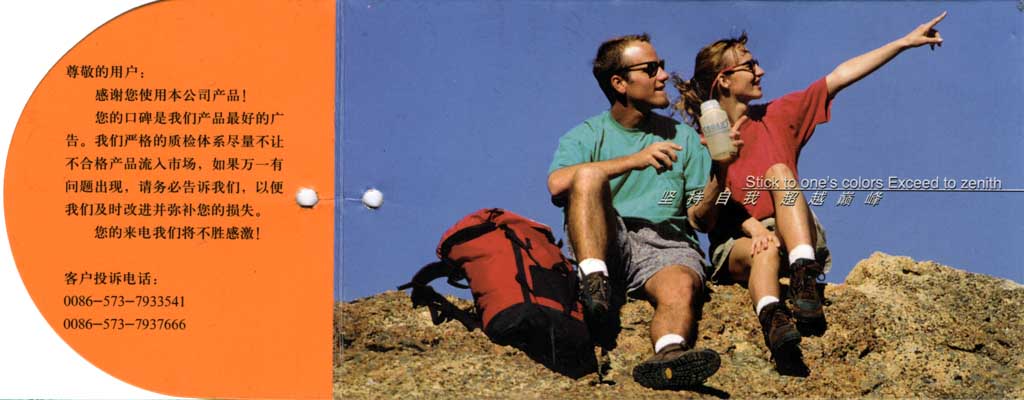
China may not have had any advertising during the time of Mao but they’re making up for lost time. There are billboards everywhere, subway cars adorned in NASCAR like advertising both inside and out, abundant commercials on CCTV state television and even a cable shopping channel. Many of the faces used in advertising to the Chinese people are Cantopop or Taiwanese pop stars but a significant number of the faces used in Chinese advertising are Caucasian. Why? When I brought this to the attention of an instructor of a mandatory race and social justice class at work she explained that it was just another example of white racism and white privilege. But she’s never been to China and white racism seemed to be her answer to every question in the spirit of, “If all you have is a hammer, everything looks like a nail”. Here’s an example, on trips to China I bought a bag for my laptop and a small belt bag made by a company called Littlesheep. The bags were of good quality and very reasonably priced. Here’s the tag that I clipped off the computer bag, both front and rear (click to enlarge):

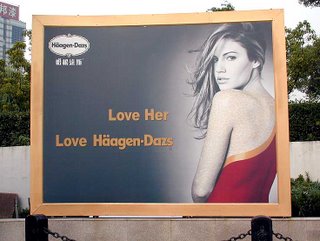
The couple in the picture probably don't live in China and they don't look like 99.9% of Littlesheep's target market. But my guess is that to the average Chinese shopper they represent the good life, one filled with lots of stuff and plenty of leisure time and after decades of suffering and sacrifice caused by the economic missteps of clumsy communism who wouldn't want that? Here's another example from Shanghai that I shot in November 2005 on HuaiHai Rd, Shanghai's main fashion street

Here's the webpage of Haagen-Daz China. See anybody Chinese there? It's not just foreign companies that do this either. Here's the website of a Chinese clothing manufacturer, Vider. No Chinese faces here either. Zhonghuacar is a subsidiary of Brilliance Auto, a Chinese company that makes BMW and Mitsubishi knockoffs as well as genuine Chinese made BMW’s. It’s definitely a Chinese company, Zhonghua in Chinese means China. Does anybody have an explanation for this?

Saturday, June 10, 2006

Pandas!

They sure are cute but, they're bears. They eat bamboo and not much else. Before I visited the Chengdu Research Base of Giant Panda Breeding in Sichuan province I'd never seen bamboo growning before. The Chinese government has sent a few giant pandas to North America.

Pandacams: You can see the pandas at the National Zoo in Washington, DC here: http://nationalzoo.si.edu/Animals/GiantPandas/default.cfm?cam=LP2 The San Diego Zoo has giant pandas too, you can them here: http://www.sandiegozoo.org/zoo/ex_panda_station.html

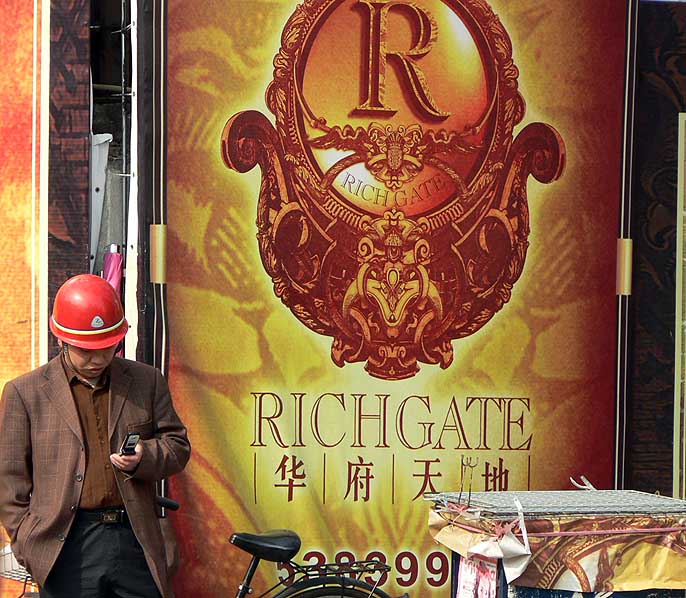
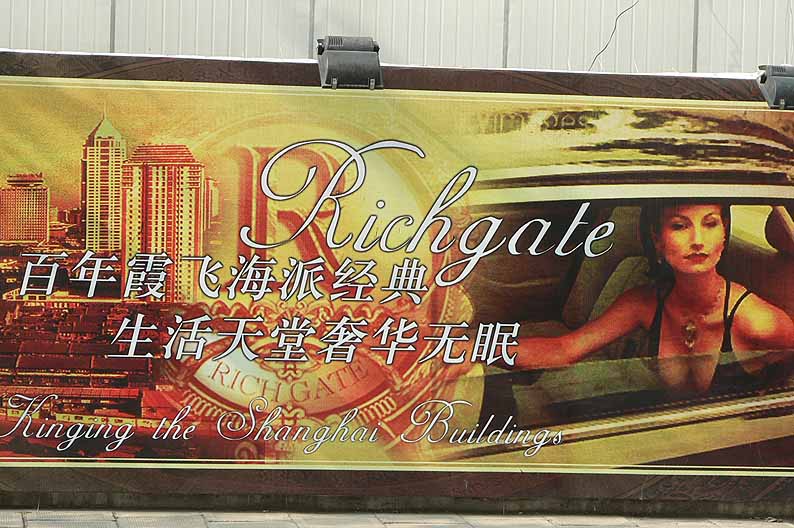
Richgate - "Kinging the Shanghai Buildings"

Meet Satan, Shanghai condo developer. This poster flogging this condo project, supposedly the toniest in Shanghai, strikes me as sinister. Who else but Satan himself could get away with a name like Richgate in a supposedly communist country?

Naturally a development this gaudy and over the top deserves an equally gaudy website (in Chinglish).

Sunday, May 28, 2006

Chinglish Choice

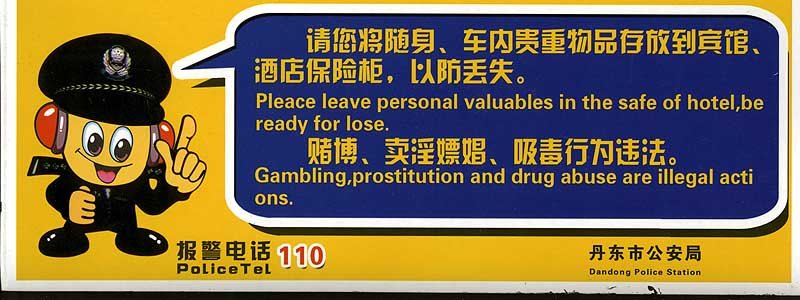
I get it, leave valuables in the hotel safe or they could get stolen.  Or, “be ready for lose”. 

Every blog on China seems to have some obligatory Chinglish and it would be bad ju-ju for me to upset this tradition. As for just what Chinglish is check out Wikipedia's extensive entry Many humerous examples here: http://www.engrish.com/ There's no need to hunt down Chinglish in China, it's everywhere so it finds you. It's usually well meaning on the part of the writer and I still wonder why the Chinese think it's necessary to have English (or their own unique interpretation of it) everywhere. I'm glad that they do it, it means that I can read street signs and figure out where I'm going on the metro and get just a little bit less lost.

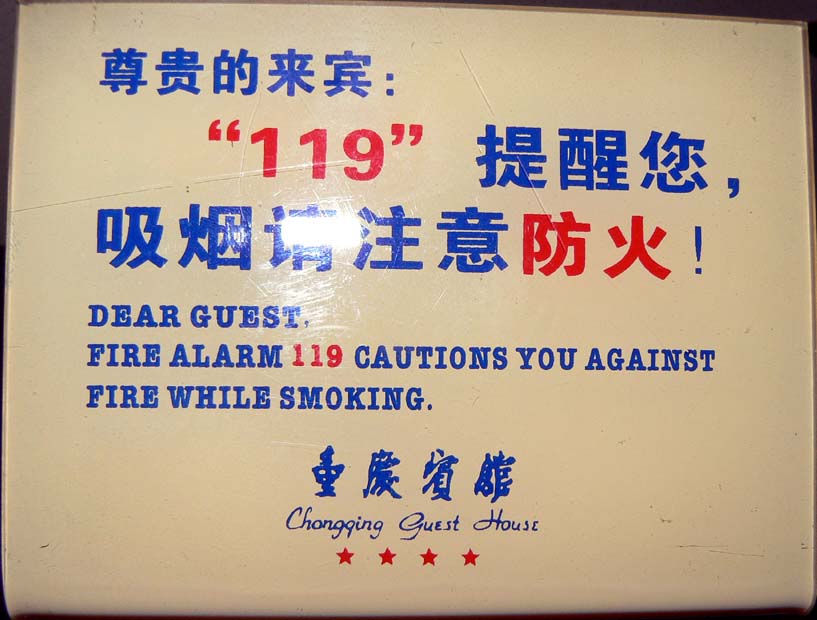
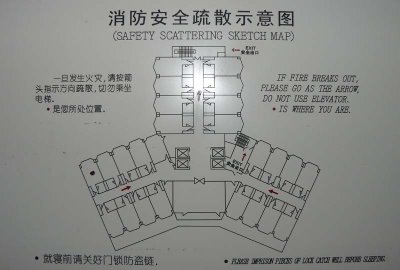
Behold! Maybe this is the origin of the phrase "Chinese Fire Drill". I found this on the inside of the door of my room at the Jin He Hotel in Chengdu.

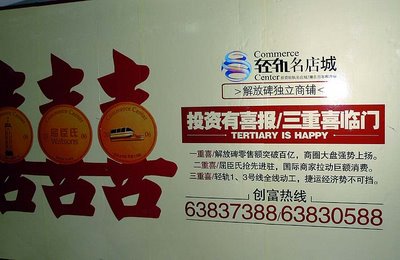
Like most Chinglish the true meaning can be grasped after some thought. I found this one outside of a monorail station in Chongqing. It shows 3 businesses that have done well in the shopping center by the monorail. So "Tertiary Is Happy" probably means that good things come in threes. Or not.

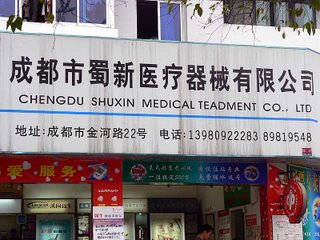
Just a misspelling, I hope.

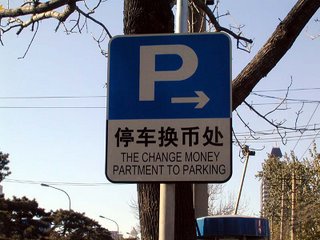
From Beijing: I have no clue of what they were trying to tell me. Change for parking? Since only a complete stark staring suicidal lunatic would attempt to drive in any Chinese city I didn't have to concern myself with whatever this is.

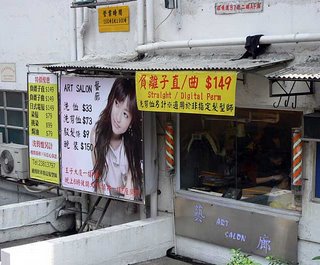
This one's from Hong Kong. English is one of Hong Kong's official languages so they ought to know better, unless I'm not up on my art and fashion and there is something called a digital perm.

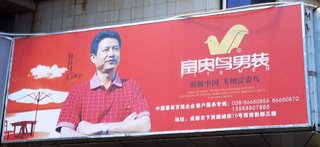
Check this guy out, I shot this billboard in Chengdu. The text says, "The strongest potential makes the Chinese arrogant Men's clothing brand". Change the word arrogant to confident and it suddenly makes more sense.

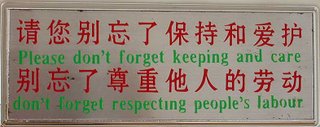
This is from Dandong on the North Korean border. I found it outside a men's room. It means more than just keep the place clean.

The message is helpful, noble yet strangely phrased.

Why go to China?

Why not? Friends and coworkers keep telling me that I'm brave to go to China, especially on my own. I don't feel any great sense of bravery, I go for the adventure and adventure is wherever I find it. Is language a problem? Chinese is a tough language and at my age I realize that I'll never write the great Chinese novel and I'll never master Putongua. But as an English speaker I encounter more English in China than I ever saw in France and more than I've seen in some American cities.

Worried about getting lost? Don't. You'll be able to read most street signs, subway stops and even some billboard advertising thanks to pinyin. That's the Chinese system of Romanization of written Chinese characters.

Food: Don't let the lack of chopstick training hold you back, get hungry and go to your nearest Chinese restaurant to work out with the sticks. While everyone outside of the showcase Chinese cities will most likely notice that you're a foreigner (and maybe even point and tell their friends) it's the rare restaurant in China that will automatically offer you a fork. I stayed out of hole in the wall restaurants due to health concerns and the realization that I could never communicate with the staff. I was always nervous about appearing ignorant but usually the staff would try to meet me halfway. English is taught in most Chinese schools and there is usually someone around who can show off what little English they remember.

Expect cultural food differences though. When I told someone at dinner that I didn't eat beef but that chicken was OK she summoned the waitress and ordered something in Chinese. What arrived is in the picture on the right. No, that's not chocolate. It's chicken blood.

Water: The water supply in China is not up to snuff when compared to the water supply in North America. One waterborne pathogen that takes root could result in several days of wasted vacation at the very least so why risk it? Bottled water in the US is marketed and priced as a fashion accessory but in China it's available everywhere and it's cheap too. 500 ml of pure water for the People can be had for 1¥, sometimes less. That's about .12 US. Even the fleabag hotels that I complained about usually spotted me a bottle or 2 of purified water daily.

The Cybercafe

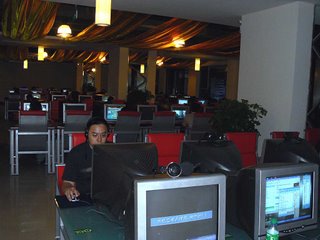
Back when communists ruled parts of Asia and central and eastern Europe shortages of everything was their trademark. In Chengdu my communist era hotel was providing a free communist era Internet connection. It was a 100 megabit Ethernet hookup but I maybe Chairman Mao was standing on the Internet garden hose. I wished I could upgrade to dialup. The solution? I went to the cybercafe. This one In China each user must sign in at the front desk with their government issued ID cards in order to be granted access. The kids running the front desk didn't know what to make of me, I couldn't read the government form and they couldn't read my passport to fill the form out for me so after forking over 3 or 4 Yuan they indicated that I could sit anywhere in the large room that I preferred.

It was a large hot room filled with adolescent youth and and hot computer equipment. It was already a hot day and this place was on the 2nd floor of a mini-mall. It was uncomfortable but I had things to do, such as finding out why I couldn't reach my Hotmail account via my own laptop. The Chinese government never admits to censoring the Internet but supposedly that's just what they did to accessing Hotmail from within China I was by far the oldest person in the cybercafe, probably 3 times the ages of the kids running the place. Grandpa Gweilo had come to town, let's all flash him our best gang signs! I left after about an hour and a half, I had gotten the information that I wanted and I could no longer take the stifling heat or my clothes sticking to my chair and my skin sticking to my clothes. When I went to leave I was surprised to be handed my change for the time unused (I had no idea how much time had purchased, I just wanted Internet access and the price was more than right).

Let's take more pictures with my new best friends!

Saturday, May 27, 2006

Breakfast at the local bakery

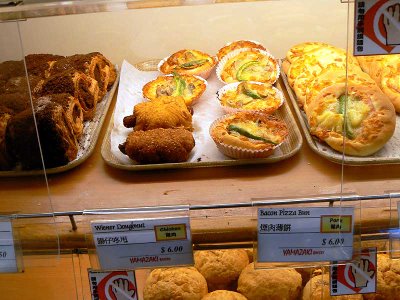
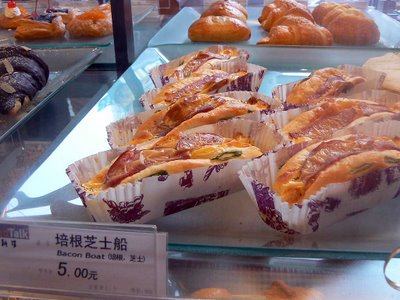
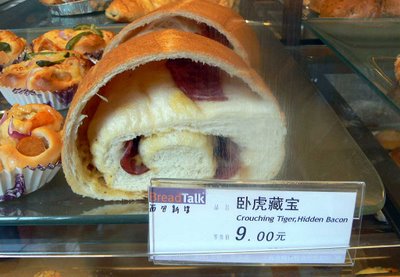
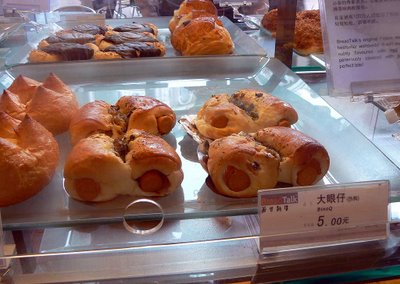
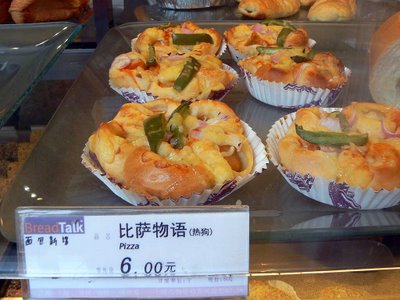
Perhaps it's my own bias but I usually think of pastries and similar baked goods as European in origin. The stereotype I've subscribed to says that Asians get their starch from rice, Europeans (and by extension most Americans) get theirs from wheat and similar grains. Maybe not. In Asia I was surprised to find bakeries with elaborate cakes, breads and pastries everywhere. The format is usually the same, the customer grabs a tray and a set of tongs and selects their choice from small transparent bins. The selections are totaled and paid for at the cash register. So they have bread and pastry in Asia. Naturally there are some local variations on the usual bakery fare, how else to explain the "weiner doughnut" or the "bacon pizza bun" that I found at the Yamazaki bakery outlet in Kowloon:

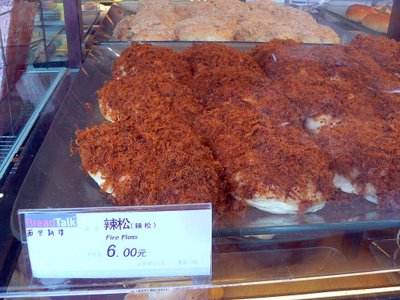
Then there's Breadtalk. They're based in Singapore but have franchised stores in Hong Kong, China and Taiwan. They're upscale, efficient and just a bit exotic. Behold the Firefloss:

This isn't the floss that you use to clean teeth: it's shredded processed muscle fiber.

Wednesday, May 24, 2006

Strange Taste Horsebeans?

What are Strange Taste Horsebeans? I picked up a small package of them at a rest stop on a bus trip from Chengdu, Sichuan to Chongqing. They're strange alright; crunchy, sweet, hot and salty in succession. Not bad. A nice change from tortilla chips and dip or Cheez Doodles. But what's with the name? It's like this all over China. English is in, it's fashion, it's the way that the Chinese think that they can communicate with all non Chinese speakers. But the differences between Chinese, a language based on characters and English, a language based on letters combined with the easy availability of inaccurate Internet based machine translations make for awkward Chinglish. Horsebeans are more commonly known in English as broad beans or Fava beans. Sounds better already, no? The "strange taste" is indeed a unique taste. Chongqing's Unique Tasting Fava Beans, now those might sell in the export market because the product ain't bad and there's nothing currently like it on this side of the Pacific.

Tuesday, May 23, 2006

Chinese radios

Some people buy stuffed animals or other tchotchkes as souvenirs when they travel. Me, I buy radios. Last year when I was in Dandong I bought one of these for about $25 US:

Yes, the front of the radio is in Chinese. On this trip I came home with another Tecsun radio, this one was $53 at Carrefour: This one's in Chinese too. A review is here I'm not sure why I do this, maybe I'm just a collector in denial. There's certainly not much worth list to on the radio these days and it can be argued that shortwave listening has been rendered obsolete by satellite communication and the abundance of audio streams available on the Internet. I dunno, I just like 'em.

What trade imbalance with China?

PJ O'Rourke is one of my favorite writers, in this article he questions the accepted notion of America's trade imbalance with China:
But there is no such thing as a trade imbalance. Trade can't be out of balance because a balance is what a trade is. Buyers and sellers decide that one thing is equivalent to another. Free trade is balanced trade. You might as well have free love then claim your partner had sex but you didn't. And a certain American president did claim that. Maybe Monica Lewinsky is in charge of America's China policy.
Click here for the entire article

Monday, May 22, 2006

Gasoline

When I was in China in May 2006 the price of gasoline was significantly cheaper than it is in the US. The price of premium gasoline was about $2.40 US for a four quart US gallon, almost one US dollar cheaper than home. It's said that the Chinese government keeps the price of fuel artificially low to stimulate their domestic economy. It appears that the difference will narrow a bit since gasoline prices in China are set by the central government and that central government has decided on a price hike. Which means that they're still selling fuel at a loss.

Sunday, May 21, 2006

Enron

Everything's for sale in China, even pandas. Back when Enron was flying high they got all warm and fuzzy and invested $5000 in a giant panda. I've been searching the web, so far no leads on when Ken Lay and Jeff Skilling are hiding little Enron the panda.

Fashion! For Men! China Style!

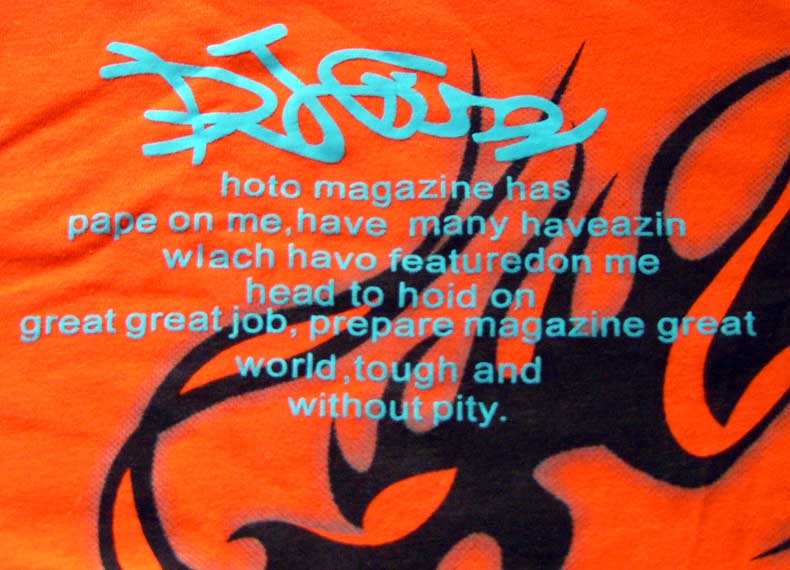
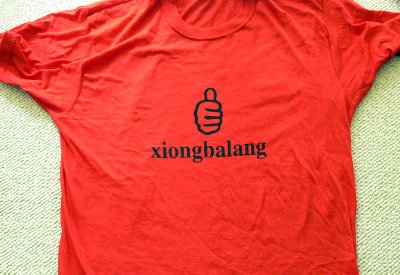
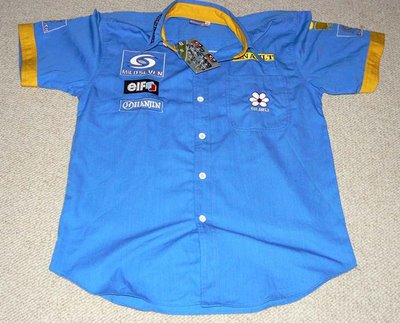
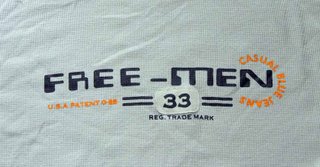
Now that I'm back home nearly everything I read makes sense. I can walk into just about any restaurant and make sense of the menu, no more taking the waitress to the tables of my fellow diners so I can grunt and point. Unfortunately for me even the conversations of passersby now make sense. At least all of the T-shirts slogans I see make sense. All of them except mine. When I ran out of clean shirts in Chongqing I went on the hunt for the goofiest, most inane T-shirts I could find. A fool's errand? Not in China, everybody wears them. I now have a golf shirt that says,

Golf: The Purpose of the golf link to urnamen is to adsance the game of golf

None of these shirts was purchased in shady knock-off joints, they were all bought at a French based chain Carrefour.

I'm going to be getting some strange looks this summer because I'm going to be a walking billboard for men's fashion in China.

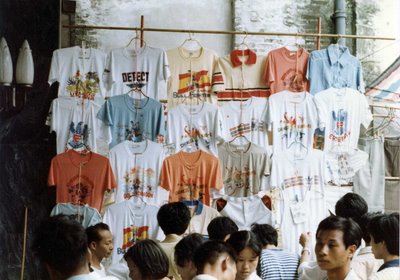
(Below) I took this picture in Guangzhou in 1982. Notice the English on most of the shirts.

Let the Good Times Roll

Mao is right on the money, quite literally. He's on every denomination of Yuan notes so Mao is near and dear to everybody in the new China. He's in the textbooks of their kids and there's often a big statue of him in their town squares. In Chengdu a massive Mao gazes over the development of a new multi-block high end shopping plaza and the new subway that's being built to get Chengdu's citizens to the goods that they want from that new multi-block high end shopping plaza and back home again. In Dandong a giant Mao salutes the Real Love disco.

Mao wouldn't recognize the place. China has outgrown orthodox "workers control the means of production" communism because China has proved conclusively that communism just can't accomplish the basics of providing the food and fuel average folks need, let alone the luxuries they desire and dream of. In sidestepping communism it has brought prosperity to many of it's citizens. It's true, China still has 800 million rural, dirt farming peasants. It used to have more and plenty of urban peasants too. Even the Bang-Bang army in Chongqing bear their heavy burdens because as bad as it is it's better than life down on the farm. The ocean of good old classic iron fisted state planning in the world has dried up into a small dirty little puddle. That kind of good old time classic communism can only be found in garden spots like North Korea and Cuba and it's subjects are kept penned in physically and ideologically by fences and censorship. On the big collective farms that those countries are ideological purity is sprinkled liberally with power shortages, unemployment and famines. China had wide spread famines that starved millions to death in the late 1950's and 1960's, thanks in no small part to that guy on the banknotes.

In today's China food is cheap and all of the stores I saw are overflowing with quantity and quality. Chinese food stores have apples from New Zealand and Washington state, bananas from the Philippines and almonds from California. The English language China Daily from May 16th said that doctors here are running into something never before seen on a large scale before in China; type 2 diabetes. Many of it's citizens never had it so good and they want the good times to continue to roll. China's system is one not seen by the world before. If it ain't communism then what is it? It isn't democracy in the sense of voting for the candidate and party of your choice and the right to stand up on a soapbox in Tiananmen Square and say that the Communist Party of the People's Republic of China is ideologically hypocritical and full of crap. There's only one political party permitted, the "Communist Party", even if it's communist in name only. Coca Cola had cocaine in it way back when but even though the coke is gone from Coke it remains the name of the brand. In China perhaps the name "communist" is just traditional, part of China's branding.

So maybe it doesn't matter what the party in power is called or what it does just as long as it delivers the goods and they don't piss off too many people in the process. China does that sometimes, since the central government owns all the land they can decide that a new mega-mall or chemical plant or condo project is going to be built where your house is now. Be gone in 30 days because the bulldozers are coming they'll tell you and give you a paltry payoff while others get rich with the kind of in your face corruption that Enron could only dream of. China's new industry needs electricity and much of it comes from burning dirty coal. When the state electricity grid decides to build a new coal fired power plant in your neighborhood you don't have much recourse beyond living with it or moving someplace else. Is the ruling Communist party delivering the goods? In my travels it appears to me that they are. Traditional classic communism usually took a country with lots of nothing and made sure that the nothing was spread around equitably. This usually resulted in every body having an abundance of nothing and nothing else. China's been there, done that. There are no cell phones in North Korea, they're banned by the ruling Worker's Party. Cuba has a few because nobody has money for such a luxury. China has more cell phones than there are people in the US, over 300 million and increasing rapidly. I was in Guangzhou for a few days in 1982., there were next to no cars and everybody wore the same clothes and cheap black cotton shoes. Everything looked worn out and run down. The Chinese don't have to read their history books to find out how bad things were in recent Chinese history (assuming the government would accurately print that history where some 80 million died due to Communist Party ineptitude and indifference), they lived through the famines, the scorning and punishment of intellectuals and the purging of innovators or those with contrary ideas. It's recent enough for many to have lived through it, they know what depravation and unbridled state power are like.

The Chinese people want air conditioners, cars, good food with variety, computers, Kentucky Fried Chicken, Starbucks Coffee, Wal-Mart and they want to go on vacations overseas. Oh, and they want fashion and they want it in abundance. If there's one English word I saw over and over on store fronts, the sides of cars and motorcycles and emblazoned in glitter across teen aged girl's chests it's F*A*S*H*I*O*N. They don't always spell it properly but they pursue it at the makeup counters, jewelry and clothing stores with a single minded gusto that suggests that they're making up for lost time and they want to enjoy the party before some bubble headed bureaucrat with more ideology than brains changes his mind. So I saw T-shirts with English gibberish ("World's Greatest Lovers, We Don't Move!", "#1 Killboy" on a 5 year old), women of all ages tottering around in high heels and lots of young people of both sexes with dyed hair.

Saturday, May 20, 2006

Bang-Bang: In Their Own Words

Click here for interviews with some members of Chongqing’s bang-bang army.

Chongqing, bang-bang!

Yangtze river

In 1997 the central government in Beijing carved off the piece of Sichuan province where Chongqing (pronounced Chong-ching) is located and made it the municipal equivalent of a province. So most everything about Sichuan cooking applies to Chongqing, which means that edible things can be chili hot and everything is saturated in oil. Yesterday I slipped and fell down about 5 stairs. Today I did it again and I've got a nice welt on my left arm and a scrape on my right wrist. There is so much oil in Western China that they're spreading it on sidewalks and stairways? The chilies melted the soles of my shoes? Ever since I've arrived in China people have been staring at my feet, specifically my shoes. I guess that they're fashion conscious. I'm wearing a pair of Asics Kayano running shoes because they're comfortable. They're made somewhere in China by a Japanese company but possibly only for export.

Chongqing municipality has about 31 million people of which at least 10 million live in Chongqing city. The central government in Beijing has been pouring billions into this city to make it the industrial, business and cultural hub of western China, sort of China's Chicago on the Yangtze river. Chongqing is where Ford, and Suzuki build cars, A large Chinese company named Lifan builds motorcycles and cars here. Chongqing has a monorail (more on that later), skyscrapers and they've done up their sidewalks and stairways in tile. It's been raining and to my running shoes that wet tile might as well be glare ice. Gotta be careful out there before I come home with my black and blue butt in a sling.

Chongqing-Yangtze-cable-carPlanning means a lot to any of these trips of mine. What to pack, where to stay, where to go, what to do. For the Chongqing leg of this trip I blew it. For one thing, I underestimated the size of the place, it's massive. Chongqing is known as one of the three furnaces of China because of the heat but it's been wet and in the low 60's. I packed shorts and short sleeve shirts. The hotel I picked turned out to be cheap for a reason, it was a run down fleabag, a fleabag with a free blazing Internet connection. I used that Internet connection to reserve myself a room up the street at the Marriott with real A/C (it's very humid).

Back in Seattle I'd reserved myself an airline ticket from Chongqing to Shanghai and arranged to pick it up at a place I thought was nearby my hotel. Was I wrong, I took a cab clear across town and even though I don't speak much Chinese somehow I knew that the cabbie was saying, "It's around here someplace" when she turned me loose. I looked and looked, I went into businesses and presented the address in Chinese. Nobody knew where the place was and I had no idea what I was looking for. In Shenzhen I picked up my ticket at an airport kiosk, last year it was at the airport at a bank. I screwed up but the Chinese people came to the rescue, they all tried to help me or somehow told me that they didn't know. I started stopping people in the street, old men who perhaps lived in this neighborhood for years, a neighborhood that I'm sure doesn't see too many folks who look like me. I had a 2 hour window to score the ticket and it was ticking away fast. One of the locals took it upon herself to call the place that had my ticket, find out where they were and to take me there. It was nowhere near where I was looking, maybe 7 blocks away, up a dark flight of slippery stairs in and an office. If she hadn't done that I'd still be looking for that damn ticket to Shanghai. So in return I bought her lunch and then she showed me around town a bit. That's not the way I usually see a city, my way is to just plop myself down and hit the streets but seeing a city through the eyes of a local is better. We took the cable car over the Yangtze river and had a grand old time in Chongqing. She relied on her 6 years of rusty high school English which she's never used and I on a few Chinese words aided by pantomime. Planning what to pack means planning what to wear. I bought some shirts before I left but I've run out of clean ones. I considered letting the Marriott wash them but they wanted more for one shirt than it costs for a nice dinner for two so I took a different route to cleanliness. I went to Carrefour and spent the money on new shirts instead.
In the US Walmart stomps the competition but these guys give Walmart fits in the rest of the world and they've been wise not to face Walmart down on it's home turf. They stack 'em high and sell 'em cheap and globalization be damned the Chinese love it. Carrefour is a French company but all the signs in the place are in English and Chinese. I was walking around in there when I saw an employee pulling a pallet of boxes and an old woman got in her way. It sounded like she was chewing the old woman out but when the employee saw me she broke into a big forced smile and started to say "lalalalala" in mid chew-out. I might be the only round eye she's seen in awhile and I could be from the home office in France.

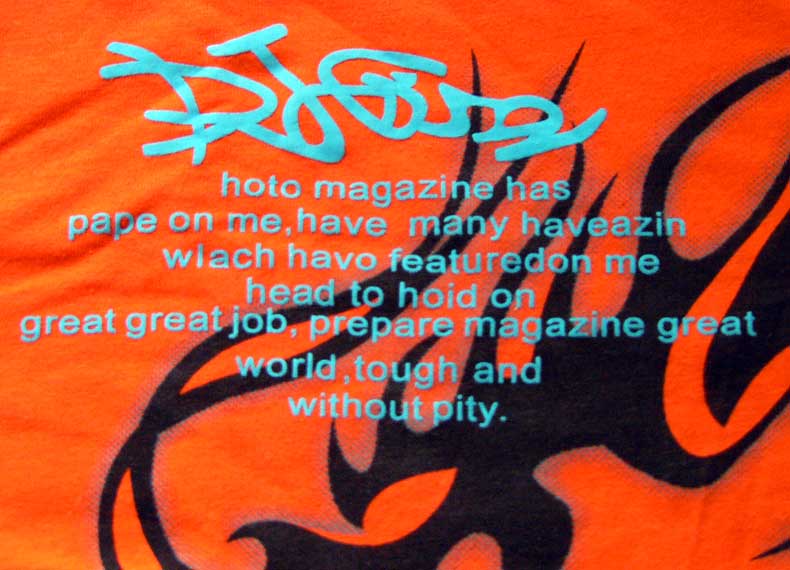
In Carrefour I was able to buy some domestic clothes and some T-shirts with the word Xiongbalang! on them. These were about $1.15 each. I turned down shirts advertising "Seattle Hornets" whoever they are. In Chinese shirt sizes I'm and XXL, that's 180 in metric. Chinese pants are trickier for a Westerner to purchase. I was able to quickly figure out my size but in China it seems that the size of one's waistline determines the length of the pants. I couldn't find pants in my length so if the weather turns cold again the hunt will continue in Shanghai. I later found out that a tailor is on duty in the store for alterations.

A big bustling city like Chongqing needs rapid transit that goes beyond cheap taxis and buses so Chongqing built a monorail. Not a toy for tourists or a political cause célèbre that's going to be a model for the nation like in Seattle but real rapid transit that for now hugs the Jiangling river. Unlike Seattle Chongqing's monorail runs for about 18 stations (more are being built) and the first 3 or so are underground. Chongqing's monorail is simply a train that runs on a different kind of track, a concrete center is hugged by rubber wheels instead of a bed with steel rails. From the inside of one of the cars it's impossible to determine that it's a monorail instead of a train that runs on tracks. There doesn't seem to be any of the Seattle romanticism over the style of the train, it's just a train that uses a different technology. The fare is cheap, anywhere from about .25 to .75 US per ride depending on the distance. Service is frequent, about every 5 minutes.

Chongqing is also famous for it's "bang-bang" people, mostly men. Bang-bang (pronounced closer to bong-bong) means stick or bamboo and is possibly where English gets that word. The bang bang army can be seen everywhere in Chongqing carrying their ropes and bamboo poles if they are looking for work or if they've found work bearing large loads hanging from the pole that they balance on their shoulders. It looks back breaking but they do the work that is often done in other Chinese cities by people on bicycles. Chongqing is too hilly for bicycles so the solution is a combination of Chinese ingenuity and Chinese overpopulation. The bang-bang army consists of uneducated recent rural arrivals in the big city who work for peanuts as beasts of burden. I saw them carrying all sorts of things; couches, chairs, tables, giant baskets of fruit. It's awful work and they're looked down upon by the locals I saw this myself, every time my friend who helped me find my plane ticket would see one of these guys she'd sing out, "Chongqing, bang-bang!" and laugh and point. Maybe it's a cultural thing but I didn't get it, these guys looked like the lowest of the low to me and to mock them struck my pampered American sensibilities as cruel. My cubicle life suddenly looks just a little less dim by comparison.