Beijing and Shanghai have had billions of dollars lavished on them for recent or ongoing international events and their citizens have been taken to charm school to smooth over bad habits such as suicidal driving, Chinglish and loud public spitting. So what about a large Chinese city that isn't on the prosperous coast and that hasn't had the benefits of the international spotlight?
Welcome to Chengdu, the capital of Sichuan province in China's interior. No obvious sophistication here, the start/end route information on the side of the #6 bus route says it all, and in English: “Engine Plant → Sewage Treatment Plant”. Chengdu has only one real internationally known attraction, the Chengdu Panda Base just outside of town. There foreigners and Chinese tourists alike oh and ah over the local and endangered bamboo eating bears with stubby legs and cute coloring. Otherwise Chengdu is a large city deep in the Chinese interior that hasn't had a reason for the central government in Beijing to put it through finishing school. People fire up butts almost everywhere, smoke free sections in local restaurants are unknown. People spit in a very loud public trumpeting exuberant phlegm clearing way that is so common that it has been described by Western expats here as the Chinese National Anthem. It sounds gross and it is too. Going for a walk? Best to forget the sandals. We rode a packed Chengdu city bus and heard a grumpy passenger go off on the driver. She screamed back at him for the entire ride. Chinglish abounds.
There's no subway yet (it's scheduled to open in October) so we took buses and cabs. Traffic is hellish. The cab drivers all drive like Stevie Wonder, in NASCAR, on meth. Which doesn't really differentiate them all that much from other local drivers. Unlike Beijing there are a fair amount of bicycles, pedicabs, mopeds and three wheeled trucks in the traffic mix too. The driver of the cabs we hailed all seem to like weaving in and out of lanes and cutting over double yellow lines to play chicken with oncoming packed city buses. Near misses seem to be the rule and it's a ballet of organized chaos that all the locals, drivers and pedestrians alike, seem to be in on. I don't pity the pedestrians, they're as fearless as the drivers and have more to lose.
For anyone who melts at the sight of a panda Chengdu is the panda Vatican. It's the headwaters of panda, the home office of cute. The pandas live up to their advance billing too, they are cute, they spend their days in captivity on display in open areas surrounded by people clicking camera shutters. The pandas don't have much to do, bamboo is delivered to them and they spend their days either playing with each other, climbing trees or on their backs chomping bamboo. Keepers dressed in blue smocks enter the enclosures when the pandas aren't looking and whisk away the panda poo. Pandas are cute but they're still powerful wild animals and when a panda decides he wants something he gets it. Tourists come from overseas, stay in nice hotels and are bused to and from the panda reserve in plush tourist buses. I imagine that other than the pandas the overseas tourists have very little contact or interactions with the locals. Just to be different Eleanor and I took a cab to the reserve and took public transit back to town. I didn't come all this distance to be isolated, if I want that I can vacation in a guarded camp.
Other than the pandas there's not much going on in Chengdu for someone who has no other reason for being there, doesn't know the place and can't pierce the language barrier. There's upscale shopping, there's middle class shopping with all of the worlds chains, there's Wal-Mart, Carrefour and their Chinese imitators like Ren Ren Le (which has shamelessly appropriated Wal-Mart's trademarked yellow smiley face) and there's shopping for the poor; a gigantic local market near the north railway station which has nearly everything at dollar store prices with dollar store quality. I bought a few Chinglish shirts but this place has everything you wouldn't want: rabbits and gerbils (rodent: it's what's for dinner), baby chicks dyed in dayglo colors that nature never intended for poultry, stuffed animals, cheap shoes, cheaper clothing, and all kinds of knock off cosmetics that fell off the back of a homemade three wheeled truck.
The food in Chengdu is outstanding and cheap and we didn't even try the local hotpot Sichuan province is famous for. Eleanor speaks enough Mandarin to make sure that we didn't order dog or chicken feet or pig blood pudding any other local specialties that might offend our (well, my) tender North American sensibilities. But some of the locals seem to take a little too well to fast food chain restaurants. KFC and McDonald's are very popular along with some Asian chains (like Dicos) and local knock-offs. Eating at these joints is somehow trendy but a burger, fries and a Coke not only is crap, it costs more than a belly plumping local lunch for two at a nice restaurant. A grande drip at Starbucks costs close to $3 US and most locals drink tea but trendy types manage to drink and be seen with the other local beautiful people at Starbucks.
Except for one slightly surly cab driver the locals were great. The folks at the Buddhazen Hotel went out of their way to help us. When we wanted to take the local bus the hotel manager didn't try to talk us out of such folly, he walked us the 3 blocks to the right bus stop. When we were looking for a nice place to go in the evening the manager took us in a cab with his girlfriend to what turned out to be a fast food chain preserve. But without Eleanor and her grade school Mandarin none of this would've happened. When I'm alone in a place like this I'm like a dog with a wallet. I can buy things but, what? I can't read (she can't either), I can't write and I can't say anything that anybody in a position to help me can understand. I can pantomime but unless you're Marcel Marceau that looks stupid. Besides, I long ago got tired of the various kind of gestures I've thought up when I really need the mens room.
More China awaits. Next stop: Shanghai and the World Expo.
Click here for Chengdu pictures.
Click here for panda pictures & video.
Showing posts with label carrefour. Show all posts
Showing posts with label carrefour. Show all posts
Thursday, May 27, 2010


Tuesday, May 23, 2006
Chinese radios
Some people buy stuffed animals or other tchotchkes as souvenirs when they travel. Me, I buy radios. Last year when I was in Dandong I bought one of these for about $25 US:


Sunday, May 21, 2006
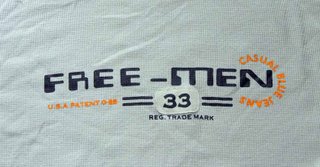
Fashion! For Men! China Style!
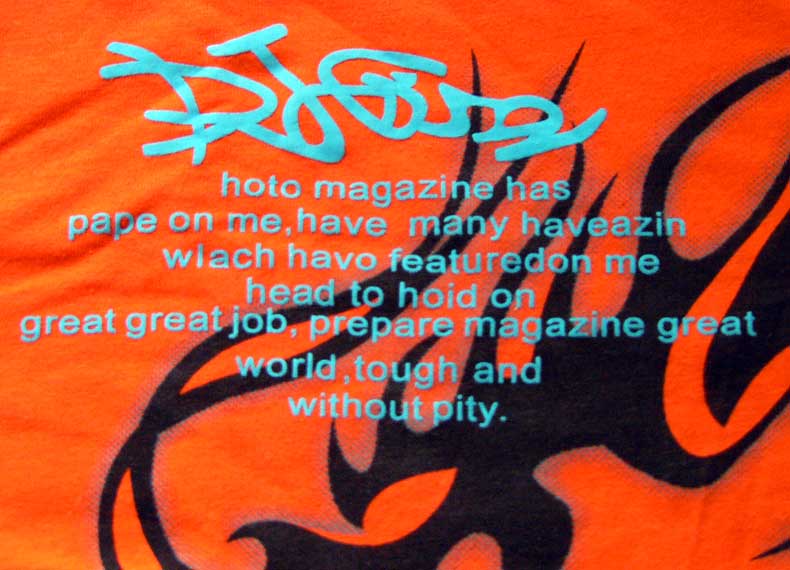
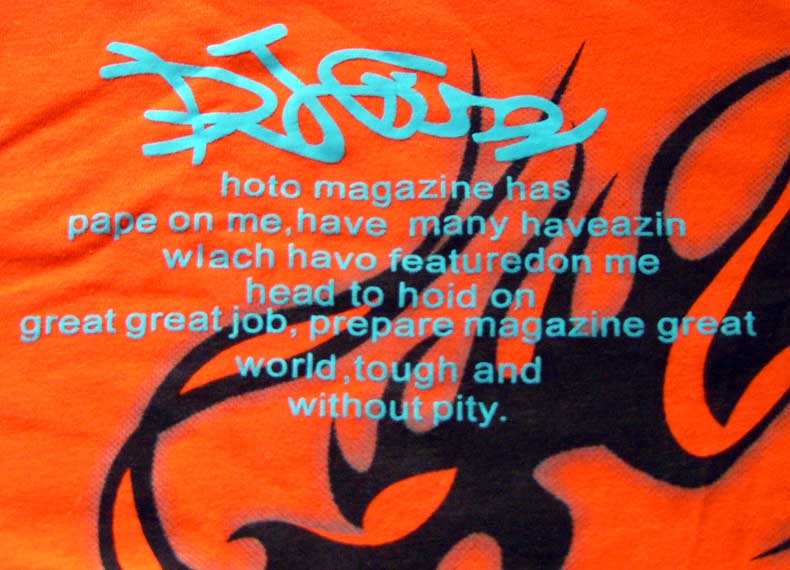 Now that I'm back home nearly everything I read makes sense. I can walk into just about any restaurant and make sense of the menu, no more taking the waitress to the tables of my fellow diners so I can grunt and point. Unfortunately for me even the conversations of passersby now make sense. At least all of the T-shirts slogans I see make sense. All of them except mine. When I ran out of clean shirts in Chongqing I went on the hunt for the goofiest, most inane T-shirts I could find. A fool's errand? Not in China, everybody wears them. I now have a golf shirt that says,
Golf: The Purpose of the golf link to urnamen is to adsance the game of golf
None of these shirts was purchased in shady knock-off joints, they were all bought at a French based chain Carrefour.
I'm going to be getting some strange looks this summer because I'm going to be a walking billboard for men's fashion in China.
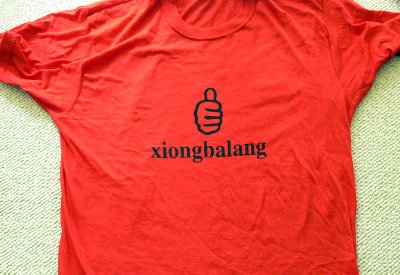
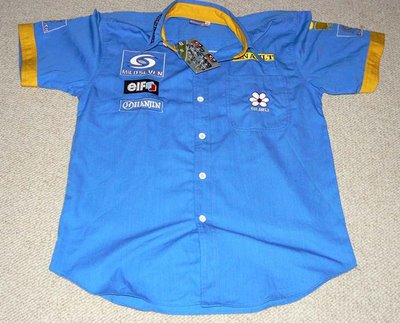
 (Below) I took this picture in Guangzhou in 1982. Notice the English on most of the shirts.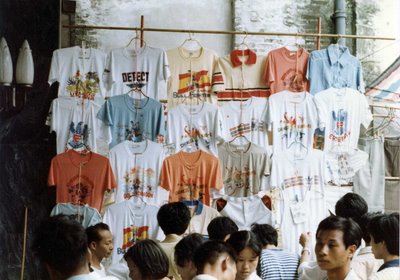
Saturday, May 20, 2006
Chongqing, bang-bang!

In 1997 the central government in Beijing carved off the piece of Sichuan province where Chongqing (pronounced Chong-ching) is located and made it the municipal equivalent of a province. So most everything about Sichuan cooking applies to Chongqing, which means that edible things can be chili hot and everything is saturated in oil. Yesterday I slipped and fell down about 5 stairs. Today I did it again and I've got a nice welt on my left arm and a scrape on my right wrist. There is so much oil in Western China that they're spreading it on sidewalks and stairways? The chilies melted the soles of my shoes? Ever since I've arrived in China people have been staring at my feet, specifically my shoes. I guess that they're fashion conscious. I'm wearing a pair of Asics Kayano running shoes because they're comfortable. They're made somewhere in China by a Japanese company but possibly only for export.
Chongqing municipality has about 31 million people of which at least 10 million live in Chongqing city. The central government in Beijing has been pouring billions into this city to make it the industrial, business and cultural hub of western China, sort of China's Chicago on the Yangtze river. Chongqing is where Ford, and Suzuki build cars, A large Chinese company named Lifan builds motorcycles and cars here. Chongqing has a monorail (more on that later), skyscrapers and they've done up their sidewalks and stairways in tile. It's been raining and to my running shoes that wet tile might as well be glare ice. Gotta be careful out there before I come home with my black and blue butt in a sling.

Back in Seattle I'd reserved myself an airline ticket from Chongqing to Shanghai and arranged to pick it up at a place I thought was nearby my hotel. Was I wrong, I took a cab clear across town and even though I don't speak much Chinese somehow I knew that the cabbie was saying, "It's around here someplace" when she turned me loose. I looked and looked, I went into businesses and presented the address in Chinese. Nobody knew where the place was and I had no idea what I was looking for. In Shenzhen I picked up my ticket at an airport kiosk, last year it was at the airport at a bank. I screwed up but the Chinese 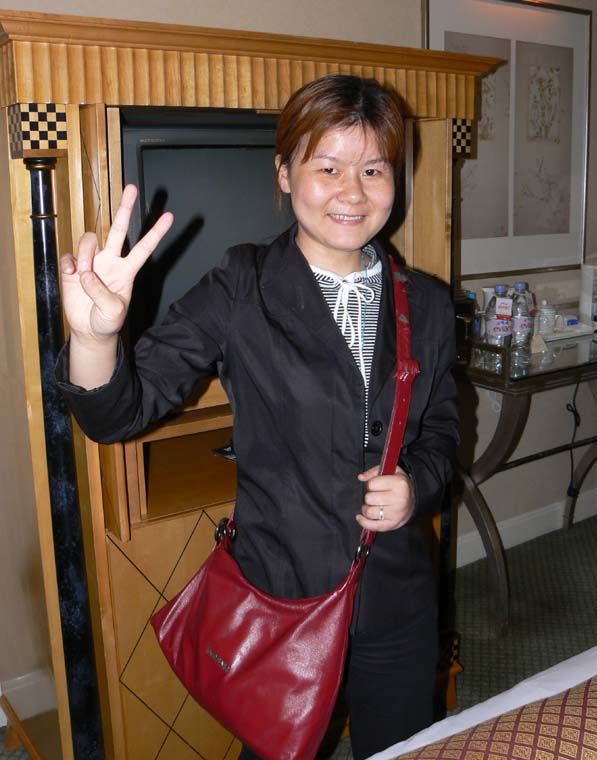 people came to the rescue, they all tried to help me or somehow told me that they didn't know. I started stopping people in the street, old men who perhaps lived in this neighborhood for years, a neighborhood that I'm sure doesn't see too many folks who look like me. I had a 2 hour window to score the ticket and it was ticking away fast. One of the locals took it upon herself to call the place that had my ticket, find out where they were and to take me there. It was nowhere near where I was looking, maybe 7 blocks
 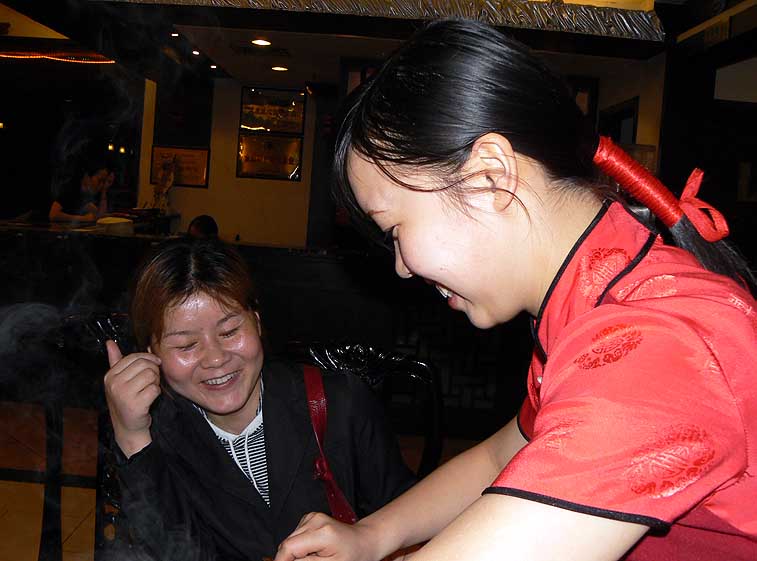 away, up a dark flight of slippery stairs in and an office. If she hadn't done that I'd still be looking for that damn ticket to Shanghai. So in return I bought her lunch and then she showed me around town a bit. That's not the way I usually see a city, my way is to just plop myself down and hit the streets but seeing a city through the eyes of a local is better. We took the cable car over the Yangtze river and had a grand old time in Chongqing. She relied on her 6 years of rusty high school English which she's never used and I on a few Chinese words aided by pantomime. Planning what to pack means planning what to wear. I bought some shirts before I left but I've run out of clean ones. I considered letting the Marriott wash them but they wanted more for one shirt than it costs for a nice dinner for two so I took a different route to cleanliness. I went to Carrefour and spent the money on new shirts instead.
In the US Walmart stomps the competition but these guys give Walmart fits in the rest of the world and they've been wise not to face Walmart down on it's home turf. They stack 'em high and sell 'em cheap and globalization be damned the Chinese love it. Carrefour is a French company but all the signs in the place are in English and Chinese. I was walking around in there when I saw an employee pulling a pallet of boxes and an old woman got in her way. It sounded like she was chewing the old woman out but when the employee saw me she broke into a big forced smile and started to say "lalalalala" in mid chew-out. I might be the only round eye she's seen in awhile and I could be from the home office in France.
In Carrefour I was able to buy some domestic clothes and some T-shirts with the word Xiongbalang! on them. These were about $1.15 each. I turned down shirts advertising "Seattle Hornets" whoever they are. In Chinese shirt sizes I'm and XXL, that's 180 in metric. Chinese pants are trickier for a Westerner to purchase. I was able to quickly figure out my size but in China it seems that the size of one's waistline determines the length of the pants. I couldn't find pants in my length so if the weather turns cold again the hunt will continue in Shanghai. I later found out that a tailor is on duty in the store for alterations.
A big bustling city like Chongqing needs rapid transit that goes beyond cheap taxis and buses so Chongqing built a monorail. Not a toy for tourists or a political cause célèbre that's going to be a model for the nation like in Seattle but real rapid transit that for now hugs the Jiangling river. Unlike Seattle Chongqing's monorail runs for about 18 stations (more are being built) and the first 3 or so are underground. Chongqing's monorail is simply a train that runs on a different kind of track, a concrete center is hugged by rubber wheels instead of a bed with steel rails. From the inside of one of the cars it's impossible to determine that it's a monorail instead of a train that runs on tracks. There doesn't seem to be any of the Seattle romanticism over the style of the train, it's just a train that uses a different technology. The fare is cheap, anywhere from about .25 to .75 US per ride depending on the distance. Service is frequent, about every 5 minutes.
Chongqing is also famous for it's "bang-bang" people, mostly men. Bang-bang (pronounced closer to bong-bong) means stick or bamboo and is possibly where English gets that word. The bang bang army can be seen everywhere in Chongqing carrying their ropes and bamboo poles if they are looking for work or if they've found work bearing large loads hanging from the pole that they balance on their shoulders. It looks back breaking but they do the work that is often done in other Chinese cities by people on bicycles. Chongqing is too hilly for bicycles so the solution is a combination of Chinese ingenuity and Chinese overpopulation. The bang-bang army consists of uneducated recent rural arrivals in the big city who work for peanuts as beasts of burden. I saw them carrying all sorts of things; couches, chairs, tables, giant baskets of fruit. It's awful work and they're looked down upon by the locals I saw this myself, every time my friend who helped me find my plane ticket would see one of these guys she'd sing out, "Chongqing, bang-bang!" and laugh and point. Maybe it's a cultural thing but I didn't get it, these guys looked like the lowest of the low to me and to mock them struck my pampered American sensibilities as cruel. My cubicle life suddenly looks just a little less dim by comparison.
Subscribe to:
Posts (Atom)