Showing posts with label Wal-Mart. Show all posts

Wednesday, June 02, 2010

Lessons Learned

Now that I’m safely back at home in North America here are some conclusions and lessons learned:
1. Three weeks of a seat of the pants touring may have been too much of a good thing. What I found adventurous when I was younger and more full of piss and vinegar is now more of a grind.  Wandering was more satisfying when I didn’t get sore feet and when I didn’t conk out as easily. But I’m still not ready for a ring through my nose organized tour.

2. Because I arrived in China without maps I had to take the time to find a map in English in each city. That meant seeking out a book store and having Eleanor ask in Mandarin if they carried any city maps in English, a time consuming chore.

3. One nice tool that I had in my travel arsenal was a WiFi equipped cell phone loaded with Fring and Onesuite. When I needed to call customer service to bitch at Orbitz when our hotel in Shenzhen didn’t have our prepaid reservation my 120 minutes of phone frustration to a phone number in Chicago cost me a cool $3. Sprint says that they charge $2.29 per minute (plus taxes and fees) to call home from China so 120 minutes would’ve cost me a frightening $274.80. Fring just reaches down into the contact list of my phone so no editing, no addition and then links you to the SIP provider of your choice. Once I had WiFi I could call any phone number in the US for a cool 2.5 cents per minute.

4. I used Boingo to access WiFi sites in China with mixed results. In Chengdu and Shanghai I was easily able to roam on China Mobile, in Shenzhen only in Starbucks. In Hong Kong outside of Starbucks Boingo was worse than useless. That’s because most of Hong Kong, including MTR stations, is covered by PCCW WiFi. The Boingo app would vibrate and chirp my phone, sometimes every few seconds, to ask me if I wanted to roam on PCCW, only to fail and spit up an error screen.  It would then ask that I send the error report back to Boingo. But without access to WiFi, Boingo’s only purpose, that isn’t possible. Then the phone would chirp, vibrate and start the whole annoying process all over again. 

*Update*  Boingo's customer service folks found this critique of their service almost instantly and as you can see below they requested more information, which I provided.  And I never heard from them again.  When I first signed up for Boingo I had an annoying problem with their software on my Android phone, it totally disarmed all wifi access on my HTC Hero.  The only cure was to wipe the phone and start all over again which I found highly annoying.  I called Boingo and they sounded very concerned and requested a detailed trouble report, which I quickly sent to the address that Boingo provided.  And I didn't hear from them again until they read the paragraph above and commented below.  Result: I cancelled Boingo.  Nice idea, poor execution.  Concerned sounding customer service is no substitute for actual tech support.

5. This ain’t your Father’s communism. I was hard pressed to find so much as a hammer and sickle in China, in three weeks I spotted just one.  Chairman Mao wouldn’t recognize the place.  I’m sure that the Chinese Communist Party is firmly in control of the country and would stomp any and all domestic challengers with the full force of the one party state. Security was tight in spots and being behind the Great Firewall is a great pain in the ass.  But China seems too busy making money or looking for ways to spend it. Who thought that China would be shopping at Wal-Mart or preoccupied with this kind of cultural revolution on state run TV?

6. I may not go back to China. The cultural gulf is so wide and the language so unintelligible that my ability to understand what I see and hear is stunted and more visits might only give me more jet lag on both ends.  At some point I just to have to shrug my shoulders and admit that there’s much I’ll just never understand.  But no organized tour could fill these gaps for me.

Thursday, May 27, 2010

Chengdu – A 2nd Tier Chinese City

Beijing and Shanghai have had billions of dollars lavished on them for recent or ongoing international events and their citizens have been taken to charm school to smooth over bad habits such as suicidal driving, Chinglish and loud public spitting. So what about a large Chinese city that isn't on the prosperous coast and that hasn't had the benefits of the international spotlight?

Welcome to Chengdu, the capital of Sichuan province in China's interior. No obvious sophistication here, the start/end route information on the side of the #6 bus route says it all, and in English: “Engine Plant → Sewage Treatment Plant”. Chengdu has only one real internationally known attraction, the Chengdu Panda Base just outside of town. There foreigners and Chinese tourists alike oh and ah over the local and endangered bamboo eating bears with stubby legs and cute coloring. Otherwise Chengdu is a large city deep in the Chinese interior that hasn't had a reason for the central government in Beijing to put it through finishing school. People fire up butts almost everywhere, smoke free sections in local restaurants are unknown. People spit in a very loud public trumpeting exuberant phlegm clearing way that is so common that it has been described by Western expats here as the Chinese National Anthem. It sounds gross and it is too. Going for a walk? Best to forget the sandals. We rode a packed Chengdu city bus and heard a grumpy passenger go off on the driver. She screamed back at him for the entire ride. Chinglish abounds.

There's no subway yet (it's scheduled to open in October) so we took buses and cabs. Traffic is hellish. The cab drivers all drive like Stevie Wonder, in NASCAR, on meth. Which doesn't really differentiate them all that much from other local drivers. Unlike Beijing there are a fair amount of bicycles, pedicabs, mopeds and three wheeled trucks in the traffic mix too. The driver of the cabs we hailed all seem to like weaving in and out of lanes and cutting over double yellow lines to play chicken with oncoming packed city buses. Near misses seem to be the rule and it's a ballet of organized chaos that all the locals, drivers and pedestrians alike, seem to be in on. I don't pity the pedestrians, they're as fearless as the drivers and have more to lose.

For anyone who melts at the sight of a panda Chengdu is the panda Vatican. It's the headwaters of panda, the home office of cute. The pandas live up to their advance billing too, they are cute, they spend their days in captivity on display in open areas surrounded by people clicking camera shutters. The pandas don't have much to do, bamboo is delivered to them and they spend their days either playing with each other, climbing trees or on their backs chomping bamboo. Keepers dressed in blue smocks enter the enclosures when the pandas aren't looking and whisk away the panda poo. Pandas are cute but they're still powerful wild animals and when a panda decides he wants something he gets it. Tourists come from overseas, stay in nice hotels and are bused to and from the panda reserve in plush tourist buses. I imagine that other than the pandas the overseas tourists have very little contact or interactions with the locals. Just to be different Eleanor and I took a cab to the reserve and took public transit back to town. I didn't come all this distance to be isolated, if I want that I can vacation in a guarded camp.

Other than the pandas there's not much going on in Chengdu for someone who has no other reason for being there, doesn't know the place and can't pierce the language barrier. There's upscale shopping, there's middle class shopping with all of the worlds chains, there's Wal-Mart, Carrefour and their Chinese imitators like Ren Ren Le (which has shamelessly appropriated Wal-Mart's trademarked yellow smiley face) and there's shopping for the poor; a gigantic local market near the north railway station which has nearly everything at dollar store prices with dollar store quality. I bought a few Chinglish shirts but this place has everything you wouldn't want: rabbits and gerbils (rodent: it's what's for dinner), baby chicks dyed in dayglo colors that nature never intended for poultry, stuffed animals, cheap shoes, cheaper clothing, and all kinds of knock off cosmetics that fell off the back of a homemade three wheeled truck.

The food in Chengdu is outstanding and cheap and we didn't even try the local hotpot Sichuan province is famous for. Eleanor speaks enough Mandarin to make sure that we didn't order dog or chicken feet or pig blood pudding any other local specialties that might offend our (well, my) tender North American sensibilities. But some of the locals seem to take a little too well to fast food chain restaurants. KFC and McDonald's are very popular along with some Asian chains (like Dicos) and local knock-offs. Eating at these joints is somehow trendy but a burger, fries and a Coke not only is crap, it costs more than a belly plumping local lunch for two at a nice restaurant. A grande drip at Starbucks costs close to $3 US and most locals drink tea but trendy types manage to drink and be seen with the other local beautiful people at Starbucks.

Except for one slightly surly cab driver the locals were great. The folks at the Buddhazen Hotel went out of their way to help us. When we wanted to take the local bus the hotel manager didn't try to talk us out of such folly, he walked us the 3 blocks to the right bus stop. When we were looking for a nice place to go in the evening the manager took us in a cab with his girlfriend to what turned out to be a fast food chain preserve. But without Eleanor and her grade school Mandarin none of this would've happened. When I'm alone in a place like this I'm like a dog with a wallet. I can buy things but, what? I can't read (she can't either), I can't write and I can't say anything that anybody in a position to help me can understand. I can pantomime but unless you're Marcel Marceau that looks stupid. Besides, I long ago got tired of the various kind of gestures I've thought up when I really need the mens room.

More China awaits. Next stop: Shanghai and the World Expo.

Click here for Chengdu pictures.
Click here for panda pictures & video.

Sunday, November 18, 2007

Guiyang People's Square: Wal*Mart & Mao


This picture shows the state of Communism in China today in a nutshell.  It’s so illustrative that it was stolen from my Flickr page and used without attribution or permission by an anti Wal-Mart website called Wal-Mart Watch.  So much for copyright protection.

This is People's Square in Guiyang. Off to the left and out of camera range there's the omnipresent giant Mao statue. On the other side of People's Square is a large mural showing the Forbidden City in Beijing, if you look closely in this picture you can make out Mao and Deng Xiao Ping, communist party heavy hitters of a bygone and failed era. People's Square has been hollowed out, what lives below People's Square in Guiyang is the largest, most densely packed, Wal-Mart Supercenter I've ever seen.

This is mid November and Christmas at Wal-Mart in China is in full swing. Right under Mao's atheist feet the store has plenty of fake Christmas trees and patrons are bathed in Christmas music, both secular and religious. It's doubtful that any of the patrons understand the lyrics but still, Bentonville would be up to its eyeballs in lawsuits and elitist complaints if Wal-Mart played hymns about the Virgin Mary in their US stores.
Communism stumbled on from 1949 until Den Xiao Ping wised up in 1979 impoverishing and stunting lives in China. The Communist Party and Mao and never give the Chinese people what Wal-Mart and Sam Walton give them every day: variety and low prices with no shortages or rationing. Communism in China couldn't put food on the table, millions died in famines that swept this country in the 1950's thanks to Mao and his state planning comrade geniuses. Political power might flow from the barrel of a gun but Wal-Mart stacks 'em deep and sells 'em cheap. You can't eat or wear the revolution.
Here's the Wal-Mart Supercenter in Kunming:


Update: If you run an trekking outfit in Nepal don't bother to post your ad here.  I will delete the spam that you repeatedly place here so fast that K2 will melt.  If you'd like to place an advertisement please contact Google and they can run your ads anywhere you'd like.  

Monday, August 14, 2006

My Life as a Tourist in China

I first went to China on a lark. In 1982 I was in Hong Kong with some time on my hands so I arranged a 3 day tour of Guangzhou. I made the trip on a ferry sailing up the Pearl river that was boarded by several nervous PLA sailors brandishing AK47s when we crossed into Chinese waters. I don’t much care for organized tours but when China first parted the bamboo curtain that tentative first crack after the death of Mao Zedong in 1976 Americans were only allowed in as part of tour groups. My second trip to China in 2005 was on another lark. I wanted to go somewhere exotic, but not so exotic that the language rendered me functionally illiterate or where I’d be confronted by a strange kind of toilet. I’m an American after all, I have my standards. Hong Kong was just what the doctor ordered. Although Hong Kong became the Hong Kong SAR (Special Administrative Region) in 1997 when the British handed it back the Chicoms in Beijing it has maintained many of its differences from the mainland under the “one country, two systems” policy. That means that unlike on the mainland cars in Hong Kong still drive on the left and have the steering wheel on the right British Empire style. Even though it isn’t widely spoken English is still one of the official languages in Hong Kong, which keeps occurrences of Chinglish down.

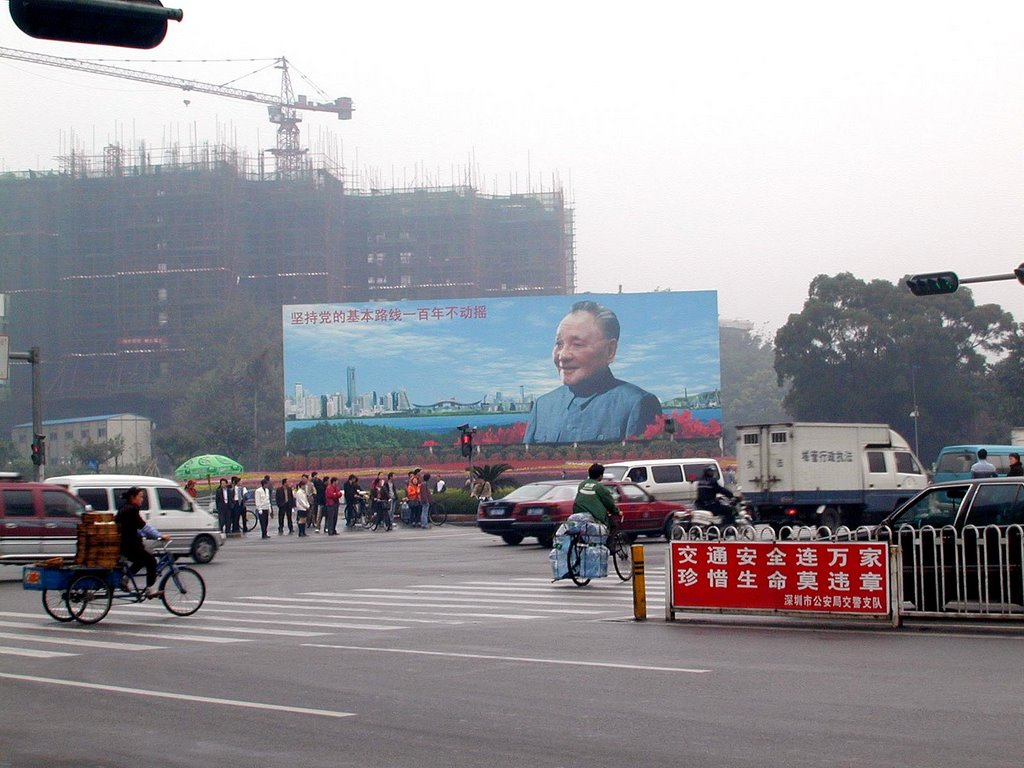
Hong Kong is a spectacular world city, for me it was China on training wheels. I enjoyed Hong Kong but I was restless to see what was on the other side of the border. Because even though the Hong Kong SAR is now part of the PRC proper the old pre-handover border remains. Hong Kong has its own customs and immigration services that are separate from those on the mainland. Getting to the border is as simple as boarding a KCRC commuter train and getting off at the last stop, Lo Wu. But I couldn’t cross the border without a visa. In another “one country, two systems” quirk American citizens need no visa to visit Hong Kong, just fly into the airport with a valid US passport and you’re in. But Americans do need a visa to cross the border from Hong Kong to the mainland, even to visit for just a few hours. Lots of inexpensive goods come from China but for American citizens a Chinese visa isn’t one of them. I arranged one through my hotel that cost me more than 800 Hong Kong dollars, that’s more than $100 US. But I wasn’t going to turn up my nose at a day trip to Guangdong province because of the cost. I wanted my all day pass to Chinaland. There are times in one’s life where you just have to open the wallet wide and do what needs to be done. The city on the PRC side of the border is Shenzhen, a bustling metropolis of 5 million that was just a fishing village at the time of Mao’s death. Deng XiaoPing used Shenzhen as a test bed for China’s economic liberalization that in retrospect was wildly successful. Unlike the rest of the mainland, Shenzhen lived economically under communism-lite and its industrial buildup was bankrolled by investors from Hong Kong looking to expand somewhere close to home and attracted by a cheap, Chinese speaking workforce. Wages were low by Hong Kong standards and labor and environmental laws were lax. Shenzhen stoked China’s economic expansion and made the then common “made in Hong Kong” label rare today. I passed through Chinese immigration and out of the train station into Shenzhen and was immediately almost hit by a car. Welcome to Chinese driving where use of mirrors or even eyes is optional and pedestrians have no rights, except maybe to be targets. I passed through Chinese immigration and out of the train station into Shenzhen and was immediately almost hit by a car. Welcome to Chinese driving where use of mirrors or even eyes is optional and pedestrians have no rights, except maybe to be targets. I found the place fascinating. Chinese buses with strange insect antenna-like mirrors plied the streets loudly belching out black exhaust. One Chinese bus manufacturer has the unusual name of “King Long”, which to me sounds better suited to a male porn star than to an outfit that makes mass transit vehicles. Look, here’s Deng Xiao Ping and one of the new businesses in booming Shenzhen:

Because China is the wild, wild east and anything goes, except anything contrary to the edicts of the Communist Party. Just ask the Falun Gong.

Sunday, May 21, 2006

Let the Good Times Roll

Mao is right on the money, quite literally. He's on every denomination of Yuan notes so Mao is near and dear to everybody in the new China. He's in the textbooks of their kids and there's often a big statue of him in their town squares. In Chengdu a massive Mao gazes over the development of a new multi-block high end shopping plaza and the new subway that's being built to get Chengdu's citizens to the goods that they want from that new multi-block high end shopping plaza and back home again. In Dandong a giant Mao salutes the Real Love disco.

Mao wouldn't recognize the place. China has outgrown orthodox "workers control the means of production" communism because China has proved conclusively that communism just can't accomplish the basics of providing the food and fuel average folks need, let alone the luxuries they desire and dream of. In sidestepping communism it has brought prosperity to many of it's citizens. It's true, China still has 800 million rural, dirt farming peasants. It used to have more and plenty of urban peasants too. Even the Bang-Bang army in Chongqing bear their heavy burdens because as bad as it is it's better than life down on the farm. The ocean of good old classic iron fisted state planning in the world has dried up into a small dirty little puddle. That kind of good old time classic communism can only be found in garden spots like North Korea and Cuba and it's subjects are kept penned in physically and ideologically by fences and censorship. On the big collective farms that those countries are ideological purity is sprinkled liberally with power shortages, unemployment and famines. China had wide spread famines that starved millions to death in the late 1950's and 1960's, thanks in no small part to that guy on the banknotes.

In today's China food is cheap and all of the stores I saw are overflowing with quantity and quality. Chinese food stores have apples from New Zealand and Washington state, bananas from the Philippines and almonds from California. The English language China Daily from May 16th said that doctors here are running into something never before seen on a large scale before in China; type 2 diabetes. Many of it's citizens never had it so good and they want the good times to continue to roll. China's system is one not seen by the world before. If it ain't communism then what is it? It isn't democracy in the sense of voting for the candidate and party of your choice and the right to stand up on a soapbox in Tiananmen Square and say that the Communist Party of the People's Republic of China is ideologically hypocritical and full of crap. There's only one political party permitted, the "Communist Party", even if it's communist in name only. Coca Cola had cocaine in it way back when but even though the coke is gone from Coke it remains the name of the brand. In China perhaps the name "communist" is just traditional, part of China's branding.

So maybe it doesn't matter what the party in power is called or what it does just as long as it delivers the goods and they don't piss off too many people in the process. China does that sometimes, since the central government owns all the land they can decide that a new mega-mall or chemical plant or condo project is going to be built where your house is now. Be gone in 30 days because the bulldozers are coming they'll tell you and give you a paltry payoff while others get rich with the kind of in your face corruption that Enron could only dream of. China's new industry needs electricity and much of it comes from burning dirty coal. When the state electricity grid decides to build a new coal fired power plant in your neighborhood you don't have much recourse beyond living with it or moving someplace else. Is the ruling Communist party delivering the goods? In my travels it appears to me that they are. Traditional classic communism usually took a country with lots of nothing and made sure that the nothing was spread around equitably. This usually resulted in every body having an abundance of nothing and nothing else. China's been there, done that. There are no cell phones in North Korea, they're banned by the ruling Worker's Party. Cuba has a few because nobody has money for such a luxury. China has more cell phones than there are people in the US, over 300 million and increasing rapidly. I was in Guangzhou for a few days in 1982., there were next to no cars and everybody wore the same clothes and cheap black cotton shoes. Everything looked worn out and run down. The Chinese don't have to read their history books to find out how bad things were in recent Chinese history (assuming the government would accurately print that history where some 80 million died due to Communist Party ineptitude and indifference), they lived through the famines, the scorning and punishment of intellectuals and the purging of innovators or those with contrary ideas. It's recent enough for many to have lived through it, they know what depravation and unbridled state power are like.

The Chinese people want air conditioners, cars, good food with variety, computers, Kentucky Fried Chicken, Starbucks Coffee, Wal-Mart and they want to go on vacations overseas. Oh, and they want fashion and they want it in abundance. If there's one English word I saw over and over on store fronts, the sides of cars and motorcycles and emblazoned in glitter across teen aged girl's chests it's F*A*S*H*I*O*N. They don't always spell it properly but they pursue it at the makeup counters, jewelry and clothing stores with a single minded gusto that suggests that they're making up for lost time and they want to enjoy the party before some bubble headed bureaucrat with more ideology than brains changes his mind. So I saw T-shirts with English gibberish ("World's Greatest Lovers, We Don't Move!", "#1 Killboy" on a 5 year old), women of all ages tottering around in high heels and lots of young people of both sexes with dyed hair.