Showing posts with label communism. Show all posts

Wednesday, June 02, 2010

Lessons Learned

Now that I’m safely back at home in North America here are some conclusions and lessons learned:
1. Three weeks of a seat of the pants touring may have been too much of a good thing. What I found adventurous when I was younger and more full of piss and vinegar is now more of a grind.  Wandering was more satisfying when I didn’t get sore feet and when I didn’t conk out as easily. But I’m still not ready for a ring through my nose organized tour.

2. Because I arrived in China without maps I had to take the time to find a map in English in each city. That meant seeking out a book store and having Eleanor ask in Mandarin if they carried any city maps in English, a time consuming chore.

3. One nice tool that I had in my travel arsenal was a WiFi equipped cell phone loaded with Fring and Onesuite. When I needed to call customer service to bitch at Orbitz when our hotel in Shenzhen didn’t have our prepaid reservation my 120 minutes of phone frustration to a phone number in Chicago cost me a cool $3. Sprint says that they charge $2.29 per minute (plus taxes and fees) to call home from China so 120 minutes would’ve cost me a frightening $274.80. Fring just reaches down into the contact list of my phone so no editing, no addition and then links you to the SIP provider of your choice. Once I had WiFi I could call any phone number in the US for a cool 2.5 cents per minute.

4. I used Boingo to access WiFi sites in China with mixed results. In Chengdu and Shanghai I was easily able to roam on China Mobile, in Shenzhen only in Starbucks. In Hong Kong outside of Starbucks Boingo was worse than useless. That’s because most of Hong Kong, including MTR stations, is covered by PCCW WiFi. The Boingo app would vibrate and chirp my phone, sometimes every few seconds, to ask me if I wanted to roam on PCCW, only to fail and spit up an error screen.  It would then ask that I send the error report back to Boingo. But without access to WiFi, Boingo’s only purpose, that isn’t possible. Then the phone would chirp, vibrate and start the whole annoying process all over again. 

*Update*  Boingo's customer service folks found this critique of their service almost instantly and as you can see below they requested more information, which I provided.  And I never heard from them again.  When I first signed up for Boingo I had an annoying problem with their software on my Android phone, it totally disarmed all wifi access on my HTC Hero.  The only cure was to wipe the phone and start all over again which I found highly annoying.  I called Boingo and they sounded very concerned and requested a detailed trouble report, which I quickly sent to the address that Boingo provided.  And I didn't hear from them again until they read the paragraph above and commented below.  Result: I cancelled Boingo.  Nice idea, poor execution.  Concerned sounding customer service is no substitute for actual tech support.

5. This ain’t your Father’s communism. I was hard pressed to find so much as a hammer and sickle in China, in three weeks I spotted just one.  Chairman Mao wouldn’t recognize the place.  I’m sure that the Chinese Communist Party is firmly in control of the country and would stomp any and all domestic challengers with the full force of the one party state. Security was tight in spots and being behind the Great Firewall is a great pain in the ass.  But China seems too busy making money or looking for ways to spend it. Who thought that China would be shopping at Wal-Mart or preoccupied with this kind of cultural revolution on state run TV?

6. I may not go back to China. The cultural gulf is so wide and the language so unintelligible that my ability to understand what I see and hear is stunted and more visits might only give me more jet lag on both ends.  At some point I just to have to shrug my shoulders and admit that there’s much I’ll just never understand.  But no organized tour could fill these gaps for me.

Monday, May 31, 2010

China’s 2 Richest Cities – Shenzhen & Hong Kong

For years Shenzhen has been the richest city in on the mainland. It's one of the biggest cities you've never heard of with a population of over 10 million people with a stock exchange, a subway system, parks, luxury hotels. Shenzhen is a factory town, the final assembly point of the iPhone and many other things in your house. The Taiwanese company responsible for iPhone assembly, Foxconn, has 800,00 employees in China, 400,000 of them in Shenzhen alone. 

30 years ago Shenzhen had a population of around 20,000. When Deng Xiaoping took over China after Chairman Mao finally shuffled off to that great collective farm in the sky he probably noticed how prosperous communism free Chinese places such as Hong Kong and Taiwan were and wanted to see what would happen if he allowed some of that capitalist evil in a corner of his kingdom. He did this first in Shenzhen and once the special economic zone was established money, factories and jobs poured over the border from higher wage Hong Kong. This transformed Shenzhen from absolutely nothing to a madhouse migrant city and Hong Kong from a city with a manufacturing economy to a city with a mostly service economy.

There's plenty of wealth out where people can see it in Shenzhen in the form of Audis, Mercedes, BMWs, Porsches and even a few Cadillacs. There's a fair amount of luxury cars tooling around on Shenzhen's wide streets with right hand drive and sets of license plates for both Hong Kong SAR and Guangdong province. While Shenzhen might be the richest city on the mainland it's the poor sister to the richest city in all of China, Hong Kong. It's a gigantic Tijuana with Hong Kong SAR playing the role of Asian San Diego. Shenzhen is a city built on hard work and other peoples money and it's paid off for many of the locals and investors. Glitzy wide shopping boulevards slowly dissolve into migrant laborer alley hells.

The women in Hong Kong are the picture of affluent fashion, their less well to do sisters in Shenzhen they seem to make it up as they go along.  After I saw the third woman in Shenzhen wearing thick, black Larry King frames without any lenses (I saw one woman stick a finger through the empty lens opening to rub her eye) I knew it wasn’t a one off aberration. 

Even with China's one child policy one thing that I've seen all over China are babies and pregnant women and Shenzhen is no exception. But due to the high cost of living babies in Hong Kong are few and far between. By day the familiar bellowing and barking of Chinese dialects on the mainland dissolves across the Hong Kong SAR border into another language. No, not Cantonese, the dialect most spoken in Hong Kong; it's the familiar puck-puck-puck of Pilipino. Hong Kong is packed with Filipinas. Although I'm sure they're out there somewhere it seems most of the male Filipinos are back home in Manila. Filipinas in Hong Kong serve as maids and nannies (as well as ply the world's oldest profession). Just as in Southern California the first words of a rich kid might be in Spanish, in Hong Kong his first words might be in Tagalog.

Unlike anywhere I’ve ever been in China, in Hong Kong you can drink the water straight from the tap. I drank Hong Kong tap and while it might be just a coincidence within 24 hours I had a roaring case of Chairman Mao's revenge. I knew I that eau de tap was graded as fit for human consumption the minute I went to a 7/11. In China 550 ml (roughly a pint) of bottled water can cost under .15 US, in fashionable Hong Kong it's .75 to a $1 US. Hotels in China usually spot their guests 2 bottles of water, in Hong Kong you can get all the water you want straight from the tap.

Hong Kong’s MTR is perhaps the best subway system in the world and riding it is a breeze.  The announcements are in 3 languages; Cantonese, Mandarin and British English.  Click here  and here for samples.

Thursday, May 27, 2010

Beijing: It’s at the 中of Everything

Beijing is more colorful, more organized and less Chinglish riddled than I remember. The glow of the lavish Beijing Olympics doesn't stop there, there's much less lusty throat clearing and public sidewalk spit splashing too. For that alone the $50 billion or whatever fortune they spent on the 2008 Olympic games was worth it.
Beijing driving is a bit less aggressive too, it's still dangerous to cross the street but the drivers are a little more Miss Manners and little less Stevie Wonder.  As everywhere in China Beijingers still bellow into their cell phones in public places, on the subway, in parks and restaurants; oblivious of those around them.  The saving grace for me is that I have no idea what they're yelling about.

We experienced no gruesome amputees sprawled across our path on the sidewalk, people with burned off faces and ears and just one dirty Mom begging with a little screaming infant that might or might not be hers and just a few blind grannies working the always crowded subway cars.

In the run up to the Olympics the government tried to infuse the locals with some manners and in some regards such as spitting they've been moderately successful. The subway now has people standing in front of the doors of subway trains telling the waiting masses to queue up on the sides of the opening doors and to leave the center for people leaving the subway car. This works beautifully and unmonitored on the orderly Taipei Metro but so far there are mixed results in Beijing. Some people queue up on the side but to enter or leave a subway car it's still best to put your head down and pretend that you're an NFL linebacker.

In the past I remember sidewalk vendors and storefronts chock full of pirated DVD's, this time I saw just one lone street DVD vendor. Plastic bags? They're not blowing in Beijing's stiff Gobi desert breeze anymore, the government decreed that stores charge .20Y (around a penny and 1/3 US) if you don't bring your own plastic bag with you to the store.

The central government dictates other behavior as well. What else am I too think when the local police look the other way at jaywalkers, suicidal driving and driving on the sidewalk but bans the use of air conditioners by calendar date and not by temperature?

The Chinese government also decides what people can and can't see on the Internet. This has been a minor pain in the ass for me as some of the pictures I upload to Flickr appear to me to be empty blue boxes. There appears to be no rhyme or reason to the logic of the Great Firewall, if I upload 3 pictures of the Beijing subway 2 might be scrubbed while the third comes through unmolested. I can read the NY Times and the Seattle Times but not http://www.publicola.net/. Even though Google left China it functions fairly normally in English but without Blogger or YouTube. There will be no blogging as the Golden Shield Project or Great Firewall has Blogger and YouTube hermetically sealed off from the 1.3 billion people within China's borders. I overcame this on previous trips to China but they seem to have plugged all of the leaks, this Blogger entry had to be uploaded later in the trip on a stopover in Hong Kong.

One positive aspect of a powerful central government is that large building projects get done in a timely fashion, the government simply decides what's best and organizes it unencumbered by lawsuits or the cries of the uprooted people in the way, they suffer for the perceived greater good. People living in the path of an office building, shopping mall or train line are sometimes given a token payment and told to be gone in 30 days. China is currently engaged in a crash program of building high speed train lines connecting its cities.

One of the first to enter service was the Beijing/Tianjin line which covers the 75 miles between the two cities in around 30 minutes at a top speed of 338 kph (observed). That's around 210 miles per hour for us non metric North American types and fast for anyone not used to measuring speed in light years. At first glance this would be wonderful for us in the US but even after having ridden China's high speed rails I'd be against duplicating this in the US. Projects like this would be tied up with lawyers feasting on them in the courts for a generation. China has more than four times the population of the US and they're concentrated predominantly in the eastern half of the country. Imagine a US with more than 4 times the people all stuffed east of the Mississippi river and you'll have an idea of what kind of density is conducive to high speed rail.

Back in Beijing we tried to see Chairman Mao in his glass casket in his mausoleum in Tiananmen Sq. He's open between 8 am and noon Tuesday through Sunday so we joined a seemingly endless line of peasants in cotton shoes and worker cadres with brown and furry teeth but halfway through the fast moving line to the old dictator a Chinese man with white gloves and a megaphone told us in Mandarin and broken English that we could bring nothing in with us. Nothing; no camera, no belt bag with wallet and passport; nothing. Of course they had a budding business of babysitting these things for a fee but I'm not leaving my consumer goodies or passport & wallet with any strangers ever.

So we wandered off to a tourist area just off of Tiananmen Sq selling Chinese tourist tchotchkes. T-shirts, caps, Chinese style blouses, panda refrigerator magnets. Eleanor likes this stuff and she indulged me two tries at seeing Mao without even a whimper of protest so I held my usual disdain for organized tourist activities and shops and did it.  This section of Beijing reminded me of any Chinatown in any city I've ever visited except this one was less than a mile from the Forbidden City, even closer to Mao's glass casket and the Vatican of the Chinese People's revolution. It's a strange world indeed.


Pictures of Beijing are here.

Next stop: Chengdu, home office of the Giant Panda.

Sunday, November 18, 2007

Guiyang People's Square: Wal*Mart & Mao


This picture shows the state of Communism in China today in a nutshell.  It’s so illustrative that it was stolen from my Flickr page and used without attribution or permission by an anti Wal-Mart website called Wal-Mart Watch.  So much for copyright protection.

This is People's Square in Guiyang. Off to the left and out of camera range there's the omnipresent giant Mao statue. On the other side of People's Square is a large mural showing the Forbidden City in Beijing, if you look closely in this picture you can make out Mao and Deng Xiao Ping, communist party heavy hitters of a bygone and failed era. People's Square has been hollowed out, what lives below People's Square in Guiyang is the largest, most densely packed, Wal-Mart Supercenter I've ever seen.

This is mid November and Christmas at Wal-Mart in China is in full swing. Right under Mao's atheist feet the store has plenty of fake Christmas trees and patrons are bathed in Christmas music, both secular and religious. It's doubtful that any of the patrons understand the lyrics but still, Bentonville would be up to its eyeballs in lawsuits and elitist complaints if Wal-Mart played hymns about the Virgin Mary in their US stores.
Communism stumbled on from 1949 until Den Xiao Ping wised up in 1979 impoverishing and stunting lives in China. The Communist Party and Mao and never give the Chinese people what Wal-Mart and Sam Walton give them every day: variety and low prices with no shortages or rationing. Communism in China couldn't put food on the table, millions died in famines that swept this country in the 1950's thanks to Mao and his state planning comrade geniuses. Political power might flow from the barrel of a gun but Wal-Mart stacks 'em deep and sells 'em cheap. You can't eat or wear the revolution.
Here's the Wal-Mart Supercenter in Kunming:


Update: If you run an trekking outfit in Nepal don't bother to post your ad here.  I will delete the spam that you repeatedly place here so fast that K2 will melt.  If you'd like to place an advertisement please contact Google and they can run your ads anywhere you'd like.  

Saturday, June 10, 2006

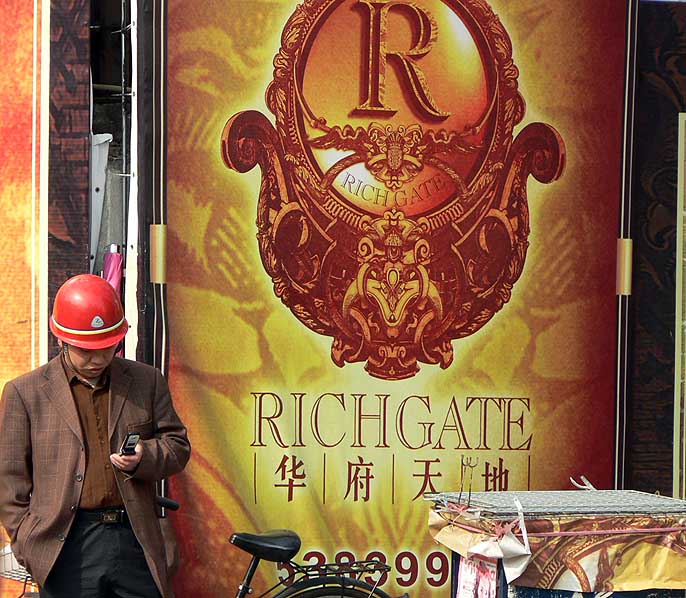
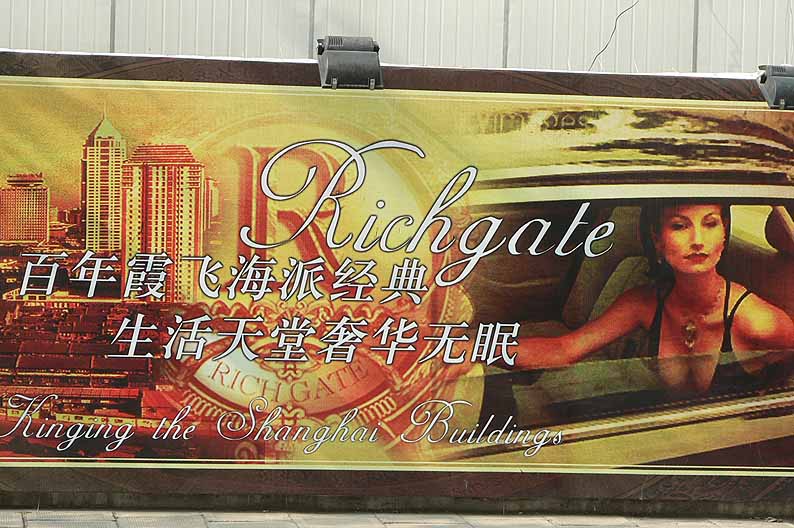
Richgate - "Kinging the Shanghai Buildings"

Meet Satan, Shanghai condo developer. This poster flogging this condo project, supposedly the toniest in Shanghai, strikes me as sinister. Who else but Satan himself could get away with a name like Richgate in a supposedly communist country?

Naturally a development this gaudy and over the top deserves an equally gaudy website (in Chinglish).

Sunday, May 21, 2006

Let the Good Times Roll

Mao is right on the money, quite literally. He's on every denomination of Yuan notes so Mao is near and dear to everybody in the new China. He's in the textbooks of their kids and there's often a big statue of him in their town squares. In Chengdu a massive Mao gazes over the development of a new multi-block high end shopping plaza and the new subway that's being built to get Chengdu's citizens to the goods that they want from that new multi-block high end shopping plaza and back home again. In Dandong a giant Mao salutes the Real Love disco.

Mao wouldn't recognize the place. China has outgrown orthodox "workers control the means of production" communism because China has proved conclusively that communism just can't accomplish the basics of providing the food and fuel average folks need, let alone the luxuries they desire and dream of. In sidestepping communism it has brought prosperity to many of it's citizens. It's true, China still has 800 million rural, dirt farming peasants. It used to have more and plenty of urban peasants too. Even the Bang-Bang army in Chongqing bear their heavy burdens because as bad as it is it's better than life down on the farm. The ocean of good old classic iron fisted state planning in the world has dried up into a small dirty little puddle. That kind of good old time classic communism can only be found in garden spots like North Korea and Cuba and it's subjects are kept penned in physically and ideologically by fences and censorship. On the big collective farms that those countries are ideological purity is sprinkled liberally with power shortages, unemployment and famines. China had wide spread famines that starved millions to death in the late 1950's and 1960's, thanks in no small part to that guy on the banknotes.

In today's China food is cheap and all of the stores I saw are overflowing with quantity and quality. Chinese food stores have apples from New Zealand and Washington state, bananas from the Philippines and almonds from California. The English language China Daily from May 16th said that doctors here are running into something never before seen on a large scale before in China; type 2 diabetes. Many of it's citizens never had it so good and they want the good times to continue to roll. China's system is one not seen by the world before. If it ain't communism then what is it? It isn't democracy in the sense of voting for the candidate and party of your choice and the right to stand up on a soapbox in Tiananmen Square and say that the Communist Party of the People's Republic of China is ideologically hypocritical and full of crap. There's only one political party permitted, the "Communist Party", even if it's communist in name only. Coca Cola had cocaine in it way back when but even though the coke is gone from Coke it remains the name of the brand. In China perhaps the name "communist" is just traditional, part of China's branding.

So maybe it doesn't matter what the party in power is called or what it does just as long as it delivers the goods and they don't piss off too many people in the process. China does that sometimes, since the central government owns all the land they can decide that a new mega-mall or chemical plant or condo project is going to be built where your house is now. Be gone in 30 days because the bulldozers are coming they'll tell you and give you a paltry payoff while others get rich with the kind of in your face corruption that Enron could only dream of. China's new industry needs electricity and much of it comes from burning dirty coal. When the state electricity grid decides to build a new coal fired power plant in your neighborhood you don't have much recourse beyond living with it or moving someplace else. Is the ruling Communist party delivering the goods? In my travels it appears to me that they are. Traditional classic communism usually took a country with lots of nothing and made sure that the nothing was spread around equitably. This usually resulted in every body having an abundance of nothing and nothing else. China's been there, done that. There are no cell phones in North Korea, they're banned by the ruling Worker's Party. Cuba has a few because nobody has money for such a luxury. China has more cell phones than there are people in the US, over 300 million and increasing rapidly. I was in Guangzhou for a few days in 1982., there were next to no cars and everybody wore the same clothes and cheap black cotton shoes. Everything looked worn out and run down. The Chinese don't have to read their history books to find out how bad things were in recent Chinese history (assuming the government would accurately print that history where some 80 million died due to Communist Party ineptitude and indifference), they lived through the famines, the scorning and punishment of intellectuals and the purging of innovators or those with contrary ideas. It's recent enough for many to have lived through it, they know what depravation and unbridled state power are like.

The Chinese people want air conditioners, cars, good food with variety, computers, Kentucky Fried Chicken, Starbucks Coffee, Wal-Mart and they want to go on vacations overseas. Oh, and they want fashion and they want it in abundance. If there's one English word I saw over and over on store fronts, the sides of cars and motorcycles and emblazoned in glitter across teen aged girl's chests it's F*A*S*H*I*O*N. They don't always spell it properly but they pursue it at the makeup counters, jewelry and clothing stores with a single minded gusto that suggests that they're making up for lost time and they want to enjoy the party before some bubble headed bureaucrat with more ideology than brains changes his mind. So I saw T-shirts with English gibberish ("World's Greatest Lovers, We Don't Move!", "#1 Killboy" on a 5 year old), women of all ages tottering around in high heels and lots of young people of both sexes with dyed hair.