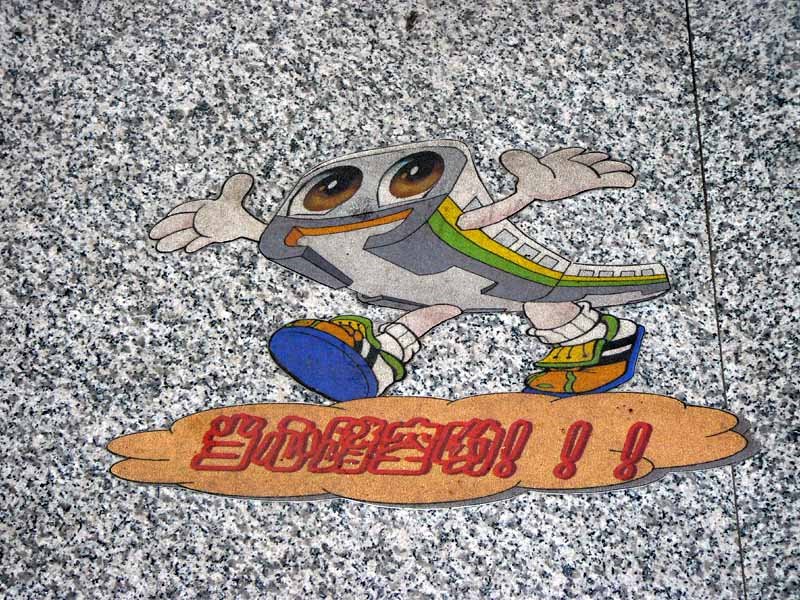
In 1997 the central government in Beijing carved off the piece of Sichuan province where Chongqing (pronounced Chong-ching) is located and made it the municipal equivalent of a province. So most everything about Sichuan cooking applies to Chongqing, which means that edible things can be chili hot and everything is saturated in oil. Yesterday I slipped and fell down about 5 stairs. Today I did it again and I've got a nice welt on my left arm and a scrape on my right wrist. There is so much oil in Western China that they're spreading it on sidewalks and stairways? The chilies melted the soles of my shoes? Ever since I've arrived in China people have been staring at my feet, specifically my shoes. I guess that they're fashion conscious. I'm wearing a pair of Asics Kayano running shoes because they're comfortable. They're made somewhere in China by a Japanese company but possibly only for export.
Chongqing municipality has about 31 million people of which at least 10 million live in Chongqing city. The central government in Beijing has been pouring billions into this city to make it the industrial, business and cultural hub of western China, sort of China's Chicago on the Yangtze river. Chongqing is where Ford, and Suzuki build cars, A large Chinese company named Lifan builds motorcycles and cars here. Chongqing has a monorail (more on that later), skyscrapers and they've done up their sidewalks and stairways in tile. It's been raining and to my running shoes that wet tile might as well be glare ice. Gotta be careful out there before I come home with my black and blue butt in a sling.
 Planning means a lot to any of these trips of mine. What to pack, where to stay, where to go, what to do. For the Chongqing leg of this trip I blew it. For one thing, I underestimated the size of the place, it's massive. Chongqing is known as one of the three furnaces of China because of the heat but it's been wet and in the low 60's. I packed shorts and short sleeve shirts. The hotel I picked turned out to be cheap for a reason, it was a run down fleabag, a fleabag with a free blazing Internet connection. I used that Internet connection to reserve myself a room up the street at the Marriott with real A/C (it's very humid).
Back in Seattle I'd reserved myself an airline ticket from Chongqing to Shanghai and arranged to pick it up at a place I thought was nearby my hotel. Was I wrong, I took a cab clear across town and even though I don't speak much Chinese somehow I knew that the cabbie was saying, "It's around here someplace" when she turned me loose. I looked and looked, I went into businesses and presented the address in Chinese. Nobody knew where the place was and I had no idea what I was looking for. In Shenzhen I picked up my ticket at an airport kiosk, last year it was at the airport at a bank. I screwed up but the Chinese 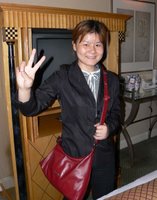 people came to the rescue, they all tried to help me or somehow told me that they didn't know. I started stopping people in the street, old men who perhaps lived in this neighborhood for years, a neighborhood that I'm sure doesn't see too many folks who look like me. I had a 2 hour window to score the ticket and it was ticking away fast. One of the locals took it upon herself to call the place that had my ticket, find out where they were and to take me there. It was nowhere near where I was looking, maybe 7 blocks
  away, up a dark flight of slippery stairs in and an office. If she hadn't done that I'd still be looking for that damn ticket to Shanghai. So in return I bought her lunch and then she showed me around town a bit. That's not the way I usually see a city, my way is to just plop myself down and hit the streets but seeing a city through the eyes of a local is better. We took the cable car over the Yangtze river and had a grand old time in Chongqing. She relied on her 6 years of rusty high school English which she's never used and I on a few Chinese words aided by pantomime. Planning what to pack means planning what to wear. I bought some shirts before I left but I've run out of clean ones. I considered letting the Marriott wash them but they wanted more for one shirt than it costs for a nice dinner for two so I took a different route to cleanliness. I went to Carrefour and spent the money on new shirts instead.
In the US Walmart stomps the competition but these guys give Walmart fits in the rest of the world and they've been wise not to face Walmart down on it's home turf. They stack 'em high and sell 'em cheap and globalization be damned the Chinese love it. Carrefour is a French company but all the signs in the place are in English and Chinese. I was walking around in there when I saw an employee pulling a pallet of boxes and an old woman got in her way. It sounded like she was chewing the old woman out but when the employee saw me she broke into a big forced smile and started to say "lalalalala" in mid chew-out. I might be the only round eye she's seen in awhile and I could be from the home office in France.
In Carrefour I was able to buy some domestic clothes and some T-shirts with the word Xiongbalang! on them. These were about $1.15 each. I turned down shirts advertising "Seattle Hornets" whoever they are. In Chinese shirt sizes I'm and XXL, that's 180 in metric. Chinese pants are trickier for a Westerner to purchase. I was able to quickly figure out my size but in China it seems that the size of one's waistline determines the length of the pants. I couldn't find pants in my length so if the weather turns cold again the hunt will continue in Shanghai. I later found out that a tailor is on duty in the store for alterations.
A big bustling city like Chongqing needs rapid transit that goes beyond cheap taxis and buses so Chongqing built a monorail. Not a toy for tourists or a political cause célèbre that's going to be a model for the nation like in Seattle but real rapid transit that for now hugs the Jiangling river. Unlike Seattle Chongqing's monorail runs for about 18 stations (more are being built) and the first 3 or so are underground. Chongqing's monorail is simply a train that runs on a different kind of track, a concrete center is hugged by rubber wheels instead of a bed with steel rails. From the inside of one of the cars it's impossible to determine that it's a monorail instead of a train that runs on tracks. There doesn't seem to be any of the Seattle romanticism over the style of the train, it's just a train that uses a different technology. The fare is cheap, anywhere from about .25 to .75 US per ride depending on the distance. Service is frequent, about every 5 minutes.
Chongqing is also famous for it's "bang-bang" people, mostly men. Bang-bang (pronounced closer to bong-bong) means stick or bamboo and is possibly where English gets that word. The bang bang army can be seen everywhere in Chongqing carrying their ropes and bamboo poles if they are looking for work or if they've found work bearing large loads hanging from the pole that they balance on their shoulders. It looks back breaking but they do the work that is often done in other Chinese cities by people on bicycles. Chongqing is too hilly for bicycles so the solution is a combination of Chinese ingenuity and Chinese overpopulation. The bang-bang army consists of uneducated recent rural arrivals in the big city who work for peanuts as beasts of burden. I saw them carrying all sorts of things; couches, chairs, tables, giant baskets of fruit. It's awful work and they're looked down upon by the locals I saw this myself, every time my friend who helped me find my plane ticket would see one of these guys she'd sing out, "Chongqing, bang-bang!" and laugh and point. Maybe it's a cultural thing but I didn't get it, these guys looked like the lowest of the low to me and to mock them struck my pampered American sensibilities as cruel. My cubicle life suddenly looks just a little less dim by comparison.