Tuesday, September 19, 2006


Thursday, September 14, 2006
Axis of Evil - Part 1

That's Chairman Mao himself outside of the train station in Dandong. When I decided to focus much of my travel on China I knew that a must see destination would be the northeastern city of Dandong. I wanted to get as close as an American citizen can to Asia’s founding member of the “Axis of Evil”, North Korea. I’ve long been fascinated with the Democratic People’s Republic of Korea or DPRK. The DPRK has been described as a Stalinist Theme Park. If the communism in today’s China can be described as Communism Lite, the DPRK is old school Commie Classic. Stalin’s USSR had no cell phones and neither does the DPRK, they’re banned. Electricity is a sometimes thing as is food. After a bad harvest a few years ago and resulting famine that claimed hundreds of thousands of lives one of the government’s slogans was, “Let’s all eat 2 meals a day”. Anyone with a fast Internet connection can watch canned broadcasts of the nightly news from Pyongyang (http://www.elufa.net/) and understanding Korean isn’t a requirement to notice that things are just a wee bit odd in the DPRK. Since the DPRK is a one party state ruled by the Korean Workers Party and the head of the party, Kim Jong Il, is known as the “Dear Leader” most of the news is about his comings and goings, such as his visits to army bases or to collective farms to dispense “on the spot guidance” and tell farmers in person what they ought to grow or not grow. Or the historic comings and goings of his father Kim Il Sung, the “Great Leader” because the DPRK is the world’s first communist dynasty. In the dead of winter the news often shows office workers in winter coats and vapor streaming from their mouths because in the energy poor DPRK if it’s cold outside it’s cold inside. Does a rocky hillside have to be moved in preparation for new construction? No problem because although the DPRK lacks modern earth moving equipment I’ve seen workers on TV breaking big ones into little ones with sledge hammers and chisels while others dutifully carry off the debris in baskets. I’d love to go and see all this for myself but there are several obstacles:
- American citizens are forbidden entry because although there's an armistice the US and DPRK are still technically at war.
-
Tourists that do make it into the DPRK are assigned minders and their itineraries are set by the government, wandering off alone and mingling with the locals is strictly prohibited.
- Why give money to to aid and strengthen brutal dictators? We’re not talking Gitmo here. Read the Aquariums of Pyongyang; if you don’t catch snakes, lizards, rats and insects to eat while you’re in a North Korean labor camp you die of starvation. After a day of forced mining or logging committing the speeches of the ruling Kim clan to memory is mandatory.
OK, so I couldn't enter the country but I could get up close and peer in. To do so I had to go to Dandong. Dandong is on the Yalu River in Liaoning province and was once a staging ground for Chinese “volunteers” who fought in the Korean War against the US. Today there’s a museum there with the pretentious cold war name of Museum Commemorating the War to Resist American Aggression and Aid Korea.
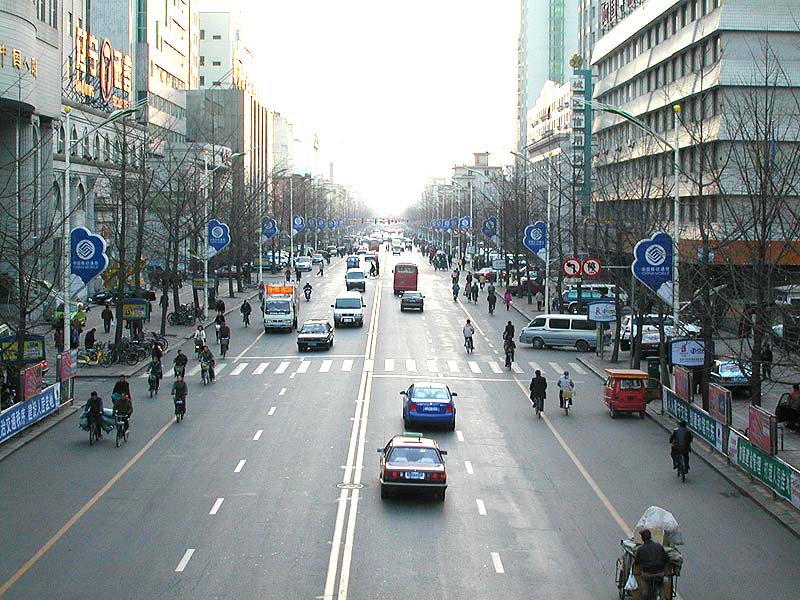
Dandong is a Seattle sized city of roughly 500,000 people and is the eastern terminus of the Great Wall of China. The Yalu River forms the border between China and the DPRK, right across the Yalu is the North Korean city of Sinuiju. I booked a "Riverview" room at Dandong’s only 4 star hotel, the Zhonglian, a room with a view, a view of North Korea.

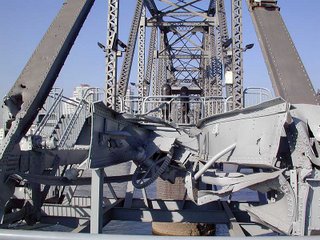
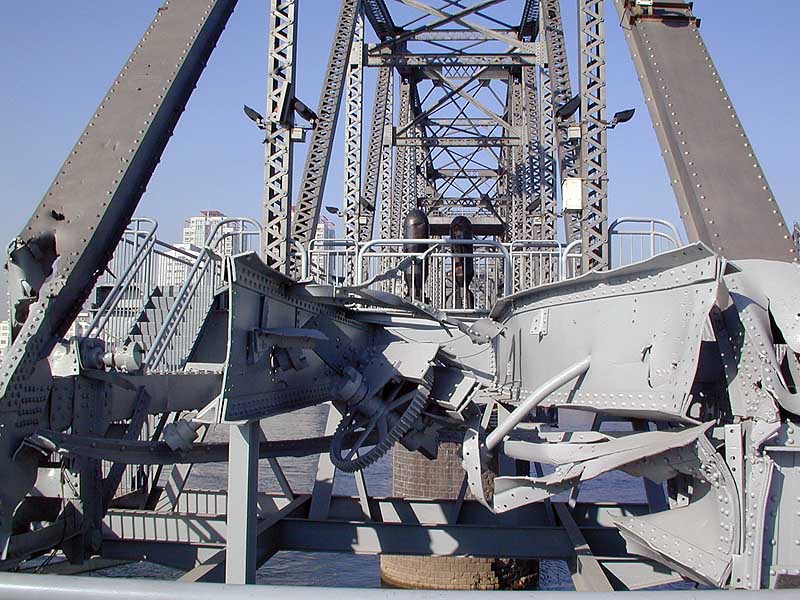
See those 2 bridges that my riverview room looked out on? Actually it’s just a bridge and a half. The austere bridge on the left connects Dandong and Sinuiju with one reversible lane for motor vehicles and one railroad track. The half bridge on the right was built during the Japanese occupation of Manchuria and was bombed during the Korean war by the US Air Force in 1950 and was never rebuilt. On the DPRK side only the footings remain. Today the “Broken Bridge” is a tourist attraction, admission 20 Yuan. My admission ticket is below.



Sinuiju has a slightly smaller population than Dandong but at night it might as well not exist, it's absolutely invisible. At night Dandong is alive with lights, cars and people on the streets or in their electrically lit homes living their lives. At night Sinuiju appears to be dead, maybe the Dear Leader sucked the life out of it. I saw no lights at all except what appeared to be somebody welding. I did see some diffused light off in the distance, I’ve since read that it’s the statue of the Great Leader Kim Il Sung which has the only artificial light in town.
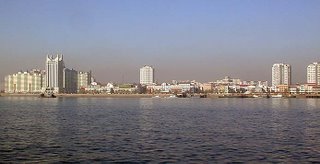
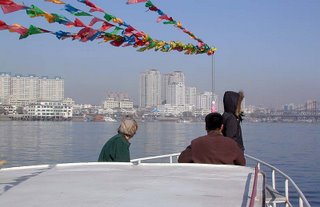
Directly above and below is Dandong as seen from a boat on the North Korean side of the Yalu. It's so prosperous it even has air pollution.
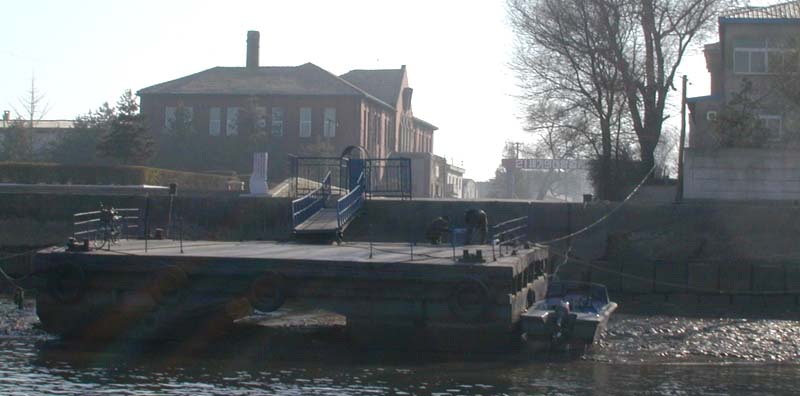

There's not much to see on the Sinuiju side of the Yalu. Plenty of rusting hulks, a few propaganda slogans (this one supposedly proclaims that Kim Jong Il is the light of the sun) and not much else. If rigid communism has any benefits they weren't evident from just offshore.
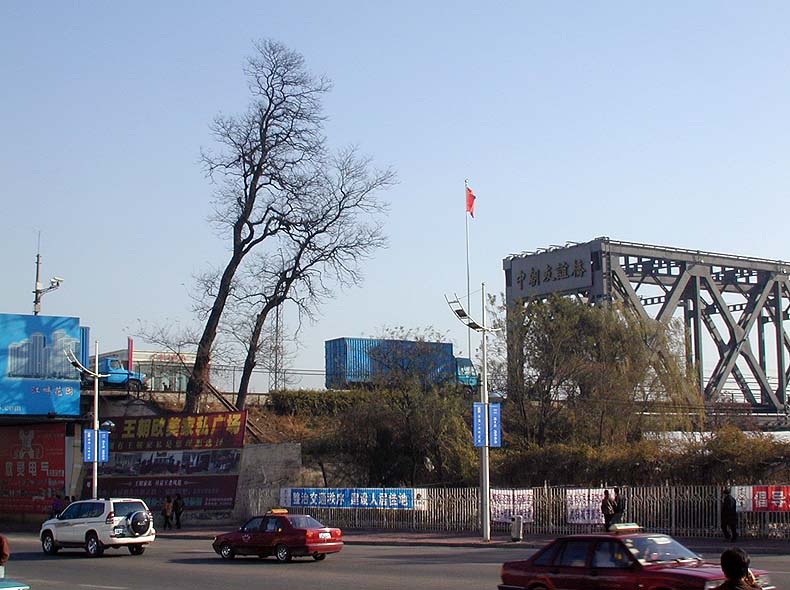
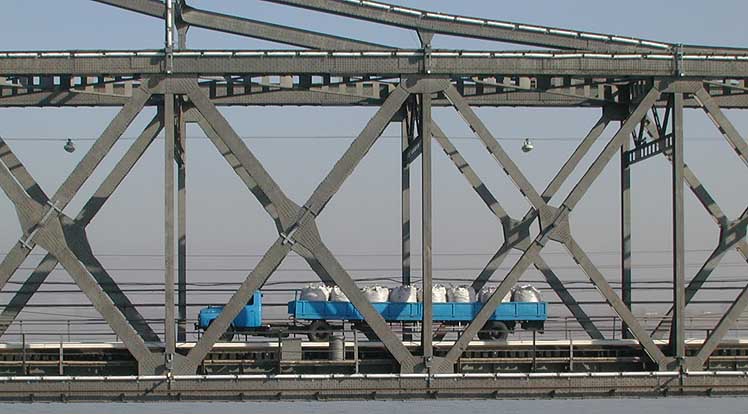
 The Great Helmsman bids you farewell.
 Sunday, September 10, 2006
Axis of Evil - Part 2
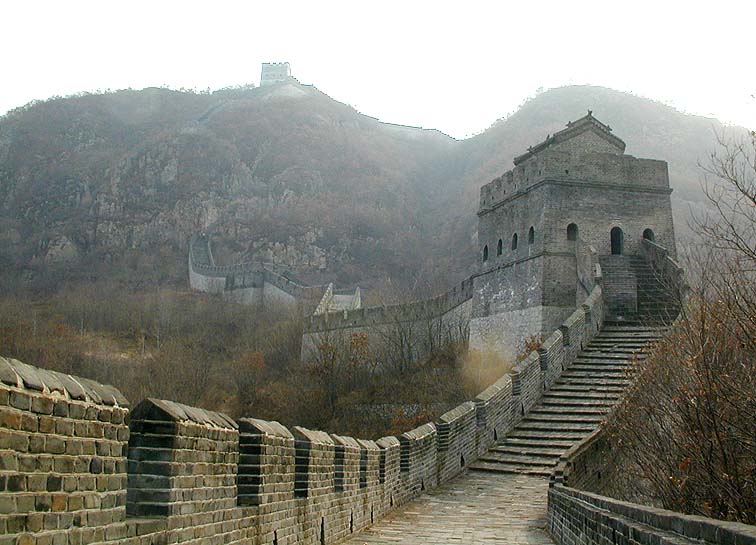
 When I was quite sure that I had seen all of North Korea that Dandong had to offer I remembered that Dandong is also the eastern terminus of the Great Wall. I certainly couldn't leave town without seeing the Great Wall so I asked the concierge at my 4 star hotel, the Zhonglian. Her English was passable, certainly better than my Mandarin but she had no idea what I was talking about. She called over a bellboy and they chatted in Mandarin about this strange laowai request. The bellboy also had no idea what I wanted. Temporarily defeated I retreated to my riverview room.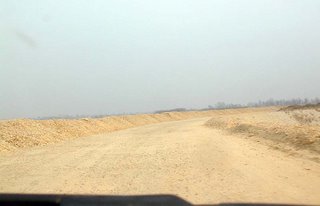
Admission to the tourist zone cost me another 30 Yuan; I passed on paying for admission to the
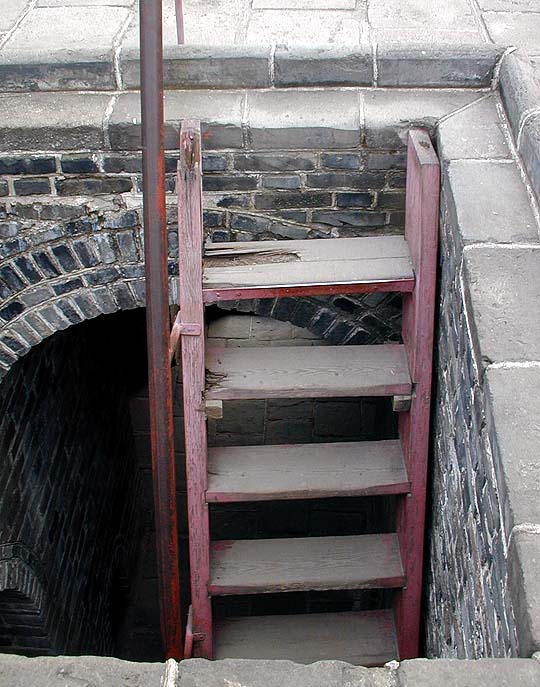
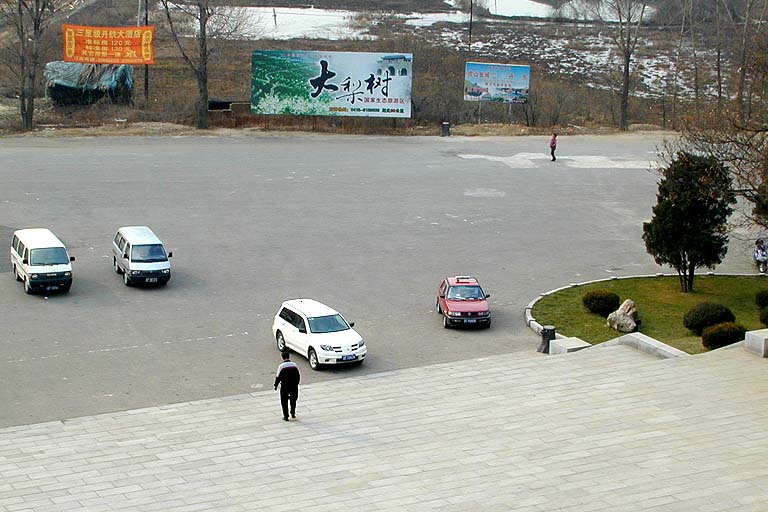
Above: my driver walks back to his red cab. The parking lot was almost empty OK, so the place needed some work. But this is the Great Wall of China! I looked around, it seemed that I had the whole place to myself. But I didn't want to let that cab out of my sight. But there was still plenty to see.

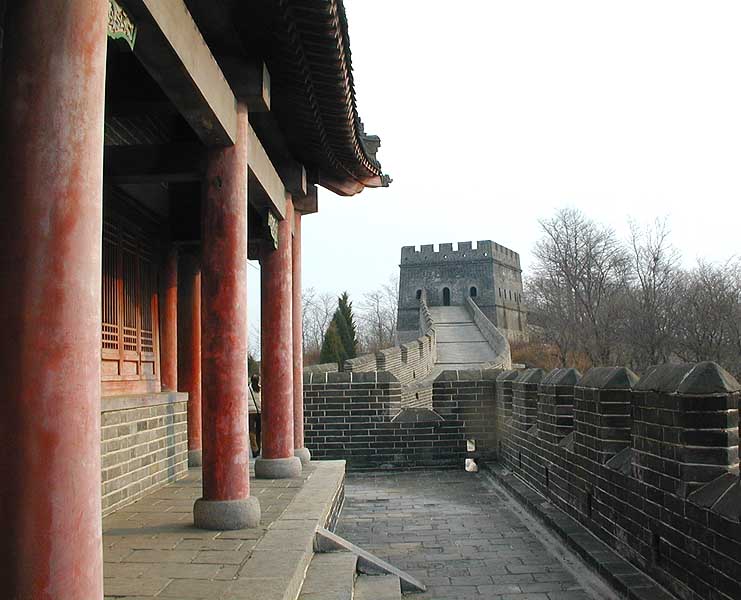
When I got back to the entrance my driver was still there, smoking a cigarette and listening to the radio. He looked at me and asked , “Choson?”, pronounced in a fast bark, Chow-sien. I already knew that the word Choson meant North Korea and thanks to the Internet I knew that the border in this area was just a small creek; perhaps he was offering to show it to me.
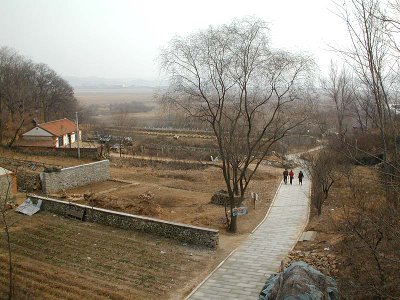

He took me to the creek that forms the border between China and the DPRK and pointed out 2 armed soldiers from the Korean People’s Army in the distance. He started to shout and wave at them. At first they ignored him but they soon started walking our way with their rifles slung over their shoulders. When they got closer a woman selling tourist nick-nacks from a cart indicated that I should buy a carton of cigarettes from her (around $6 US) and throw them across the creek. The soldiers asked who I was, the driver replied that I was an American. The woman indicated that now was the time for me to hurl the carton of smokes into North Korea. I hit the shore with the carton, the soldiers pretended not to notice. But when I lifted my camera up to my eye to get the shot they noticed that and protested loudly. When they walked away without the carton the woman who sold me the cigarettes gestured that it was alright to take a picture. I had read that the soldiers would come back for the cigarettes when there was no one around. So that’s 1/3 of the Axis of Evil. I didn’t see any actual evil on either my boat buzz of Sinuiju or my encounter with the KPA but perhaps the Kim family is keeping their reservoir of evil someplace else where I couldn’t see it.

Monday, August 14, 2006
My Life as a Tourist in China
I first went to China on a lark. In 1982 I was in Hong Kong with some time on my hands so I arranged a 3 day tour of Guangzhou. I made the trip on a ferry sailing up the Pearl river that was boarded by several nervous PLA sailors brandishing AK47s when we crossed into Chinese waters. I don’t much care for organized tours but when China first parted the bamboo curtain that tentative first crack after the death of Mao Zedong in 1976 Americans were only allowed in as part of tour groups. 

Hong Kong is a spectacular world city, for me it was China on training wheels. I enjoyed Hong Kong but I was restless to see what was on the other side of the border. Because even though the Hong Kong SAR is now part of the PRC proper the old pre-handover border remains. Hong Kong has its own customs and immigration services that are separate from those on the mainland. Getting to the border is as simple as boarding a KCRC commuter train and getting off at the last stop, Lo Wu. But I couldn’t cross the border without a visa. In another “one country, two systems” quirk American citizens need no visa to visit Hong Kong, just fly into the airport with a valid US passport and you’re in. But Americans do need a visa to cross the border from Hong Kong to the mainland, even to visit for just a few hours. Lots of inexpensive goods come from China but for American citizens a Chinese visa isn’t one of them. I arranged one through my hotel that cost me more than 800 Hong Kong dollars, that’s more than $100 US. But I wasn’t going to turn up my nose at a day trip to Guangdong province because of the cost. I wanted my all day pass to Chinaland. There are times in one’s life where you just have to open the wallet wide and do what needs to be done. The city on the PRC side of the border is Shenzhen, a bustling metropolis of 5 million that was just a fishing village at the time of Mao’s death. Deng XiaoPing used Shenzhen as a test bed for China’s economic liberalization that in retrospect was wildly successful. Unlike the rest of the mainland, Shenzhen lived economically under communism-lite and its industrial buildup was bankrolled by investors from Hong Kong looking to expand somewhere close to home and attracted by a cheap, Chinese speaking workforce. Wages were low by Hong Kong standards and labor and environmental laws were lax. Shenzhen stoked China’s economic expansion and made the then common “made in Hong Kong” label rare today. I passed through Chinese immigration and out of the train station into Shenzhen and was immediately almost hit by a car. Welcome to Chinese driving where use of mirrors or even eyes is optional and pedestrians have no rights, except maybe to be targets. I passed through Chinese immigration and out of the train station into Shenzhen and was immediately almost hit by a car. Welcome to Chinese driving where use of mirrors or even eyes is optional and pedestrians have no rights, except maybe to be targets. 
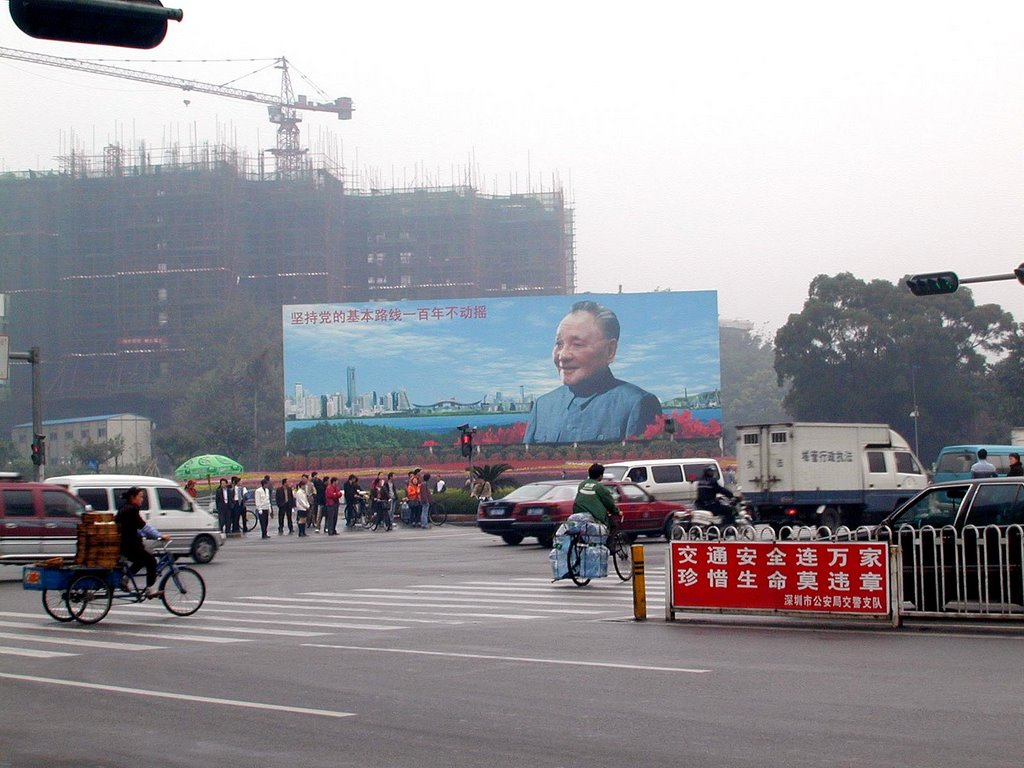

Because China is the wild, wild east and anything goes, except anything contrary to the edicts of the Communist Party. Just ask the Falun Gong.
Tuesday, June 13, 2006
Littlesheep
China may not have had any advertising during the time of Mao but they’re making up for lost time. There are billboards everywhere, subway cars adorned in NASCAR like advertising both inside and out, abundant commercials on CCTV state television and even a cable shopping channel. Many of the faces used in advertising to the Chinese people are Cantopop or Taiwanese pop stars but a significant number of the faces used in Chinese advertising are Caucasian. Why? When I brought this to the attention of an instructor of a mandatory race and social justice class at work she explained that it was just another example of white racism and white privilege. But she’s never been to China and white racism seemed to be her answer to every question in the spirit of, “If all you have is a hammer, everything looks like a nail”. Here’s an example, on trips to China I bought a bag for my laptop and a small belt bag made by a company called Littlesheep. The bags were of good quality and very reasonably priced. Here’s the tag that I clipped off the computer bag, both front and rear (click to enlarge): 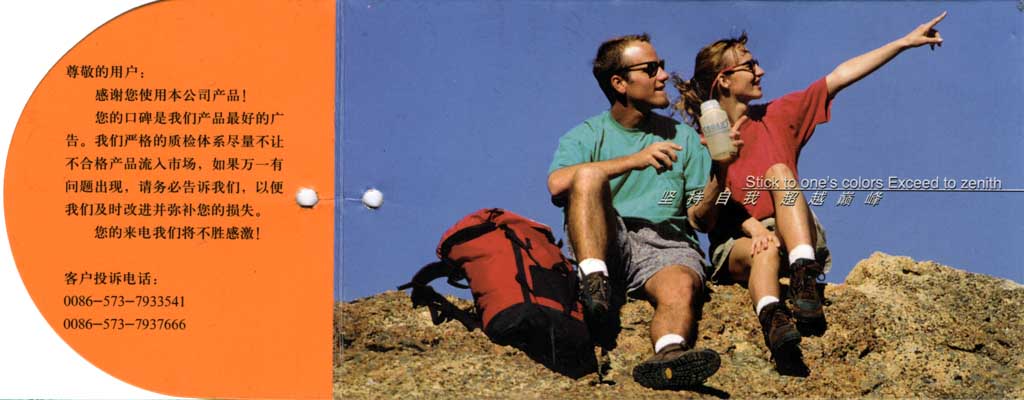

The couple in the picture probably don't live in China and they don't look like 99.9% of Littlesheep's target market. But my guess is that to the average Chinese shopper they represent the good life, one filled with lots of stuff and plenty of leisure time and after decades of suffering and sacrifice caused by the economic missteps of clumsy communism who wouldn't want that? Here's another example from Shanghai that I shot in November 2005 on HuaiHai Rd, Shanghai's main fashion street
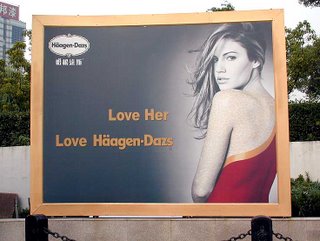 Here's the webpage of Haagen-Daz China. See anybody Chinese there? It's not just foreign companies that do this either. Here's the website of a Chinese clothing manufacturer, Vider. No Chinese faces here either. Zhonghuacar is a subsidiary of Brilliance Auto, a Chinese company that makes BMW and Mitsubishi knockoffs as well as genuine Chinese made BMW’s. It’s definitely a Chinese company, Zhonghua in Chinese means China. Does anybody have an explanation for this?
Saturday, June 10, 2006
Pandas!
They sure are cute but, they're bears. They eat bamboo and not much else. Before I visited the Chengdu Research Base of Giant Panda Breeding in Sichuan province I'd never seen bamboo growning before. The Chinese government has sent a few giant pandas to North America.
Pandacams: You can see the pandas at the National Zoo in Washington, DC here: http://nationalzoo.si.edu/Animals/GiantPandas/default.cfm?cam=LP2 The San Diego Zoo has giant pandas too, you can them here: http://www.sandiegozoo.org/zoo/ex_panda_station.html
Richgate - "Kinging the Shanghai Buildings"
Meet Satan, Shanghai condo developer. This poster flogging this condo project, supposedly the toniest in Shanghai, strikes me as sinister. Who else but Satan himself could get away with a name like Richgate in a supposedly communist country?
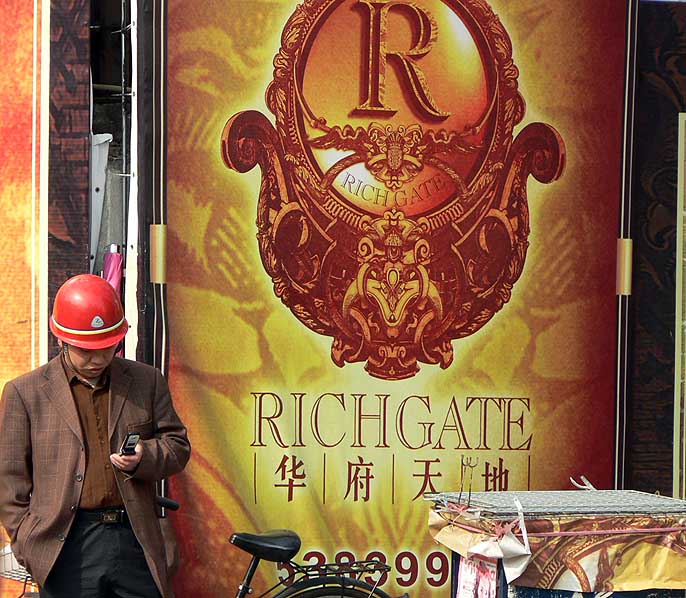 Naturally a development this gaudy and over the top deserves an equally gaudy website (in Chinglish).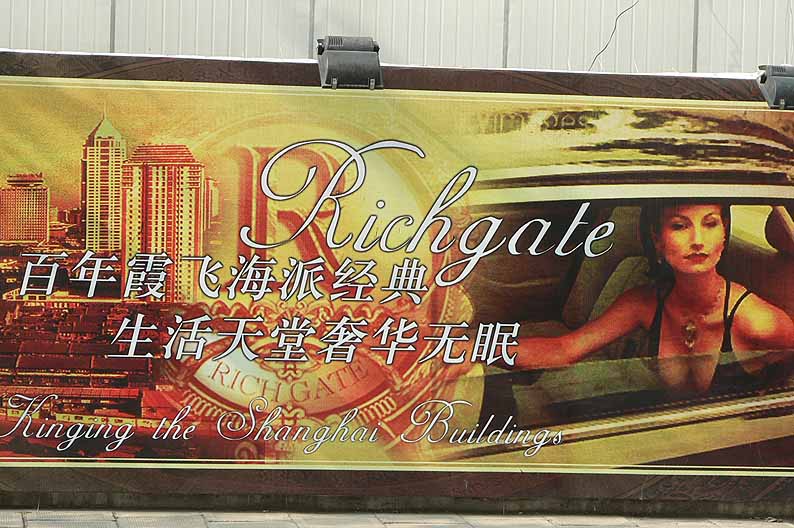
Sunday, May 28, 2006
Chinglish Choice
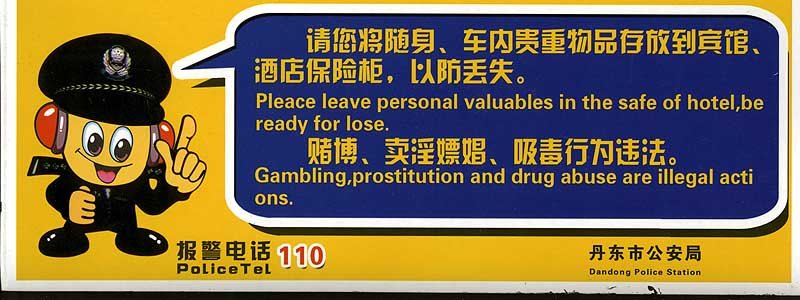 I get it, leave valuables in the hotel safe or they could get stolen. Or, “be ready for lose”.
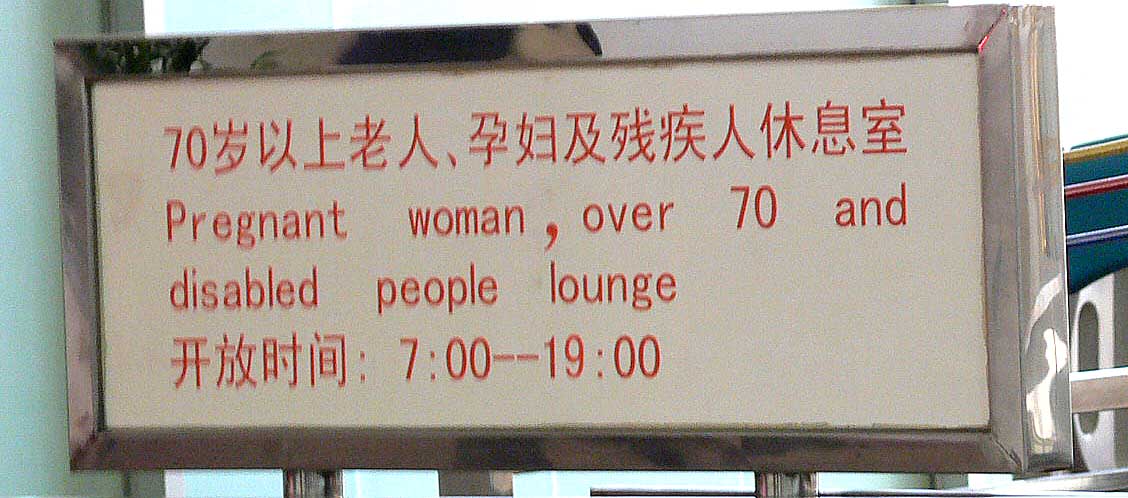
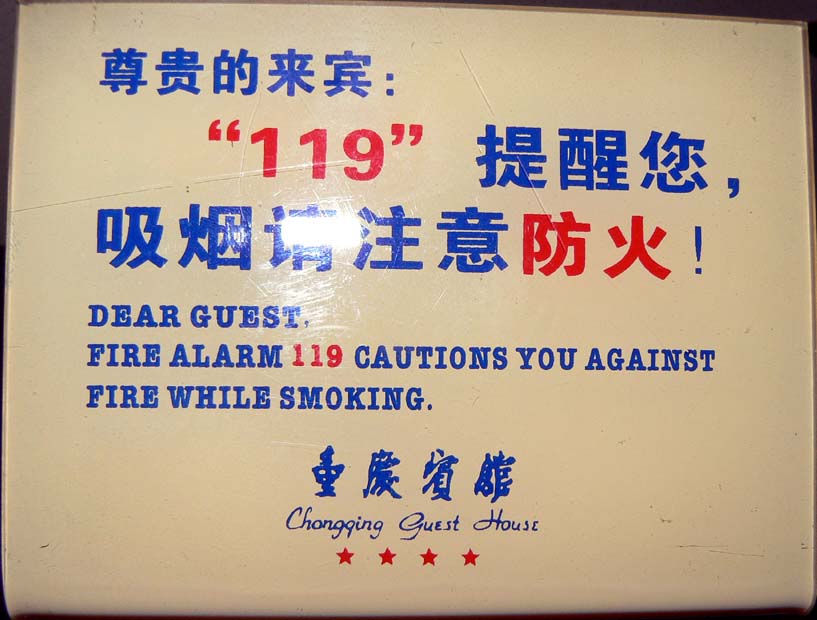 Every blog on China seems to have some obligatory Chinglish and it would be bad ju-ju for me to upset this tradition. As for just what Chinglish is check out Wikipedia's extensive entry Many humerous examples here: http://www.engrish.com/ There's no need to hunt down Chinglish in China, it's everywhere so it finds you. It's usually well meaning on the part of the writer and I still wonder why the Chinese think it's necessary to have English (or their own unique interpretation of it) everywhere. I'm glad that they do it, it means that I can read street signs and figure out where I'm going on the metro and get just a little bit less lost.
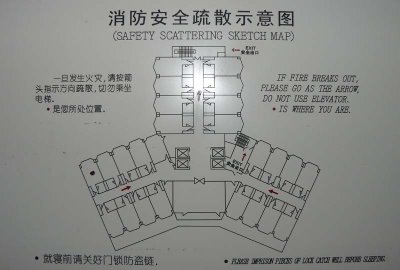
Behold! Maybe this is the origin of the phrase "Chinese Fire Drill". I found this on the inside of the door of my room at the Jin He Hotel in Chengdu.
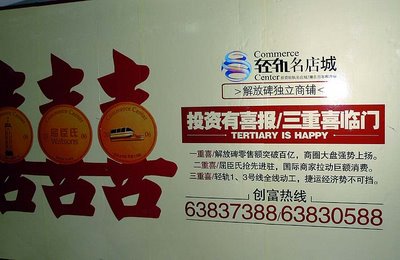 Like most Chinglish the true meaning can be grasped after some thought. I found this one outside of a monorail station in Chongqing. It shows 3 businesses that have done well in the shopping center by the monorail. So "Tertiary Is Happy" probably means that good things come in threes. Or not.
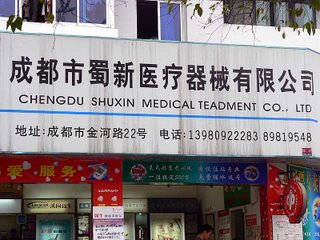
Just a misspelling, I hope.
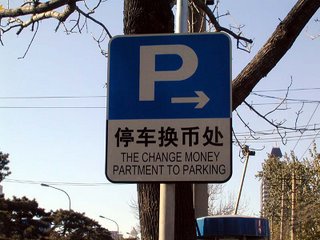
From Beijing: I have no clue of what they were trying to tell me. Change for parking? Since only a complete stark staring suicidal lunatic would attempt to drive in any Chinese city I didn't have to concern myself with whatever this is.
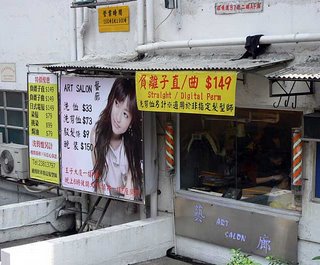
This one's from Hong Kong. English is one of Hong Kong's official languages so they ought to know better, unless I'm not up on my art and fashion and there is something called a digital perm.
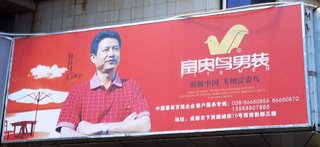 Check this guy out, I shot this billboard in Chengdu. The text says, "The strongest potential makes the Chinese arrogant Men's clothing brand". Change the word arrogant to confident and it suddenly makes more sense.
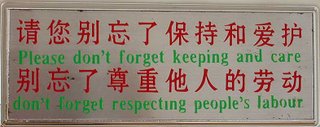
This is from Dandong on the North Korean border. I found it outside a men's room. It means more than just keep the place clean.
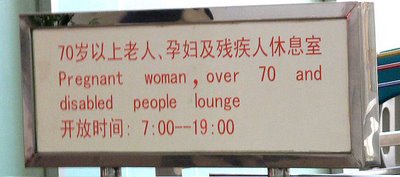
The message is helpful, noble yet strangely phrased.
Why go to China?
Why not? Friends and coworkers keep telling me that I'm brave to go to China, especially on my own. I don't feel any great sense of bravery, I go for the adventure and adventure is wherever I find it. Is language a problem? Chinese is a tough language and at my age I realize that I'll never write the great Chinese novel and I'll never master Putongua. But as an English speaker I encounter more English in China than I ever saw in France and more than I've seen in some American cities.
Worried about getting lost? Don't. You'll be able to read most street signs, subway stops and even some billboard advertising thanks to pinyin. That's the Chinese system of Romanization of written Chinese characters.
Food: Don't let the lack of chopstick training hold you back, get hungry and go to your nearest Chinese restaurant to work out with the sticks. While everyone outside of the showcase Chinese cities will most likely notice that you're a foreigner (and maybe even point and tell their friends) it's the rare restaurant in China that will automatically offer you a fork. I stayed out of hole in the wall restaurants due to health concerns and the realization that I could never communicate with the staff. I was always nervous about appearing ignorant but usually the staff would try to meet me halfway. English is taught in most Chinese schools and there is usually someone around who can show off what little English they remember.
 Expect cultural food differences though. When I told someone at dinner that I didn't eat beef but that chicken was OK she summoned the waitress and ordered something in Chinese. What arrived is in the picture on the right. No, that's not chocolate. It's chicken blood.
 Water: The water supply in China is not up to snuff when compared to the water supply in North America. One waterborne pathogen that takes root could result in several days of wasted vacation at the very least so why risk it? Bottled water in the US is marketed and priced as a fashion accessory but in China it's available everywhere and it's cheap too. 500 ml of pure water for the People can be had for 1¥, sometimes less. That's about .12 US. Even the fleabag hotels that I complained about usually spotted me a bottle or 2 of purified water daily.
The Cybercafe
Back when communists ruled parts of Asia and central and eastern Europe shortages of everything was their trademark. In Chengdu my communist era hotel was providing a free communist era Internet connection. It was a 100 megabit Ethernet hookup but I maybe Chairman Mao was standing on the Internet garden hose. I wished I could upgrade to dialup. The solution? I went to the cybercafe. This one In China each user must sign in at the front desk with their government issued ID cards in order to be granted access. The kids running the front desk didn't know what to make of me, I couldn't read the government form and they couldn't read my passport to fill the form out for me so after forking over 3 or 4 Yuan they indicated that I could sit anywhere in the large room that I preferred.
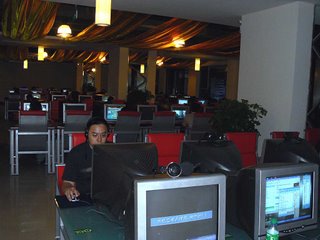 It was a large hot room filled with adolescent youth and and hot computer equipment. It was already a hot day and this place was on the 2nd floor of a mini-mall. It was uncomfortable but I had things to do, such as finding out why I couldn't reach my Hotmail account via my own laptop. The Chinese government never admits to censoring the Internet but supposedly that's just what they did to accessing Hotmail from within China
  I was by far the oldest person in the cybercafe, probably 3 times the ages of the kids running the place. Grandpa Gweilo had come to town, let's all flash him our best gang signs! I left after about an hour and a half, I had gotten the information that I wanted and I could no longer take the stifling heat or my clothes sticking to my chair and my skin sticking to my clothes. When I went to leave I was surprised to be handed my change for the time unused (I had no idea how much time had purchased, I just wanted Internet access and the price was more than right).
Let's take more pictures with my new best friends!