Better City, Better Life. That's the official phrase of Expo 2010. It's plastered in English all over Shanghai along with their rendition of Gumby which they call Haibao. Haibao appears in neighborhood squares sculpted out of bushes, in both male and female form, unlicensed bootleg stuffed Haibaos are sold by hawkers on the stairways down into subway stations. You can buy a tiny Haibao to hang from your cellphone, blow up Haibaos, all sorts of Haibao shirts, there are Haibaos that wear a Mexican sombrero, Haibaos that play the bagpipes; collect the set! Olympic tchotchkes are for sale at official souvenir stands. The Chinese public has been whipped up into a nationalistic frenzy over Expo 2010 in a similar fashion to their fervor over the 2008 Beijing Olympics.
The Chinese government supposedly spent the equivalent of $60 billion US dollars on Expo 2010, rivaling or exceeding what they spent on the 2008 Olympics. Thousands of people and business were uprooted from what is now the Expo site, new subway lines were built and brought in. There are Expo information desks staffed with young English and Chinese speakers wearing white Expo 2010 uniforms set up in subway stations, hotels, airports, shopping malls and street corners. Handles for standees on the Shanghai subway bear the Expo logo. There's an official Expo song by Jackie Chan (who also appears in ads plastered all over China and all over town for frozen dumplings, appliances, Canon and some kind of Chinese herbal hair darkening shampoo for men called Bawang. Is there anything that Jackie Chan won't shill?). Attendance figures are updated the days Expo highlights are transmitted to displays inside Shanghai's subway cars on the Shanghai Metro's TV channel every 15 minutes.
So after the Chinese government unloaded their fat piggy bank on Shanghai what's the Expo like? I found it sterile. Security is tight, tighter than any recent US domestic flight I've taken since 9/11. My possessions were x-rayed and I was fully wanded before my $13 US ticket for evening admission was accepted (a whole day at Expo 2010 costs a steep $23.50 US).
The first thing I saw after passing through the turnstile was the China pavilion. It's a massive, in your face, upside down red pyramid of a structure and very popular with Chinese fair goers. I saw no reason to go inside, it had a giant line snaking around it and I was already inside China. For me being in China is sort of like a visit to a giant China pavilion anyway so why brave the lines to see in miniature what was already before me?
The European and USA pavilions were very popular as well with lines snaking around them. But unlike most of the Chinese visitors to Expo 2010 I can probably go to these places if I want to. For most Chinese today world travel is just a dream. It's a dream that's closer to reality for your average Chinese national than it was 20 years ago and China's rich and well connected does travel internationally but for most of China's 1.3 billion it's out of reach and will remain so for their lifetimes. Expo 2010's expensive day pass will be as close as they come to seeing the cultures of the world.
With that in mind I chose to avoid most of the pavilions and exhibits. But while the throngs of Chinese fair goers had no desire to see one particular pavilion, I did. No waiting! The North Korean pavilion was much smaller and more sparsely attended than the one from South Korea but it was the #1 pavilion on my to do list. For a follower of all things DPRK such as myself who has come as close as a cruise on the Yalu river it might be as close as I come to actually experiencing the closed land of Juche. What's inside? Not much. North Korea must be a pretty boring place. There's a model of the Tower of the Juche Idea in front of a large mural of Pyongyang and a few other cheap statues, artworks and recreation. Any good souvenirs for sale? Kim pins are mandatory for DPRK citizens, maybe I could buy one to go with the one I bought years ago in Dandong? Nope, just some postage stamps and a small gaggle of Chinese Expo fanatics wanting to have their Expo 2010 passports stamped. Whoever was in charge of the placement of the national pavilions either has a sense of humor or once worked in the Bush administration, or both. Yes, Expo 2010 has its very own Axis of Evil section. Right next to the DPRK discount house of dioramas was the pavilion of the Islamic Republic of Iran, howdy nuclear neighbor!
Without the Expo Shanghai is a bustling city of 20 million or 25 million, nobody's really sure. There are many more subway lines than when I was last in Shanghai a few years ago and trains are frequent, cheap and backside to navel SRO any time of the day. The food in restaurants ranges from Chinese and American chain fast food to what to North American eyes is most unusual. A sharply dressed middle class is on the move. The women are sharp dressers who tend to wear more cosmetics, higher heels and show more skin than their poorer and more peasant western sisters in Chengdu. Thanks to the Treaty of Nanking Shanghai has more western influence than perhaps any other Chinese city except for Hong Kong. Some of old Shanghai hasn't fallen to the wrecking ball and the historic Bund along the Huangpu river has just completed an expensive makeover.
As when we took the high speed CRH train to Tianjin I had wanted to take a CRH train for a day trip to a different Chinese city. Nanjing is 2 hours from Shanghai by CRH, other cities are closer. These trains leave from Shanghai's North railway station but unlike Beijing's sedate and organized railway station Shanghai's was a madhouse of peasant migrants with stained decaying teeth bearing huge cheap plaid bundles made out of a shiny cheap tablecloth material full of god knows what along with buckets of bottled water and packages of instant noodles for their long journey on the what the Chinese call “Iron Big Brother” to the provinces. Security was tight as it is at most Chinese transit facilities so we couldn't even investigate buying tickets without waiting on long slowly moving security lines where the peasants got wanded and their bundles x-rayed so we gave up, it was simply too much of gauntlet to run.
Shanghai pictures are here
Panda pictures are here
Showing posts with label dprk. Show all posts
Showing posts with label dprk. Show all posts
Thursday, May 27, 2010


Thursday, September 14, 2006
Axis of Evil - Part 1

That's Chairman Mao himself outside of the train station in Dandong. When I decided to focus much of my travel on China I knew that a must see destination would be the northeastern city of Dandong. I wanted to get as close as an American citizen can to Asia’s founding member of the “Axis of Evil”, North Korea. I’ve long been fascinated with the Democratic People’s Republic of Korea or DPRK. The DPRK has been described as a Stalinist Theme Park. If the communism in today’s China can be described as Communism Lite, the DPRK is old school Commie Classic. Stalin’s USSR had no cell phones and neither does the DPRK, they’re banned. Electricity is a sometimes thing as is food. After a bad harvest a few years ago and resulting famine that claimed hundreds of thousands of lives one of the government’s slogans was, “Let’s all eat 2 meals a day”. Anyone with a fast Internet connection can watch canned broadcasts of the nightly news from Pyongyang (http://www.elufa.net/) and understanding Korean isn’t a requirement to notice that things are just a wee bit odd in the DPRK. Since the DPRK is a one party state ruled by the Korean Workers Party and the head of the party, Kim Jong Il, is known as the “Dear Leader” most of the news is about his comings and goings, such as his visits to army bases or to collective farms to dispense “on the spot guidance” and tell farmers in person what they ought to grow or not grow. Or the historic comings and goings of his father Kim Il Sung, the “Great Leader” because the DPRK is the world’s first communist dynasty. In the dead of winter the news often shows office workers in winter coats and vapor streaming from their mouths because in the energy poor DPRK if it’s cold outside it’s cold inside. Does a rocky hillside have to be moved in preparation for new construction? No problem because although the DPRK lacks modern earth moving equipment I’ve seen workers on TV breaking big ones into little ones with sledge hammers and chisels while others dutifully carry off the debris in baskets. I’d love to go and see all this for myself but there are several obstacles:
- American citizens are forbidden entry because although there's an armistice the US and DPRK are still technically at war.
-
Tourists that do make it into the DPRK are assigned minders and their itineraries are set by the government, wandering off alone and mingling with the locals is strictly prohibited.
- Why give money to to aid and strengthen brutal dictators? We’re not talking Gitmo here. Read the Aquariums of Pyongyang; if you don’t catch snakes, lizards, rats and insects to eat while you’re in a North Korean labor camp you die of starvation. After a day of forced mining or logging committing the speeches of the ruling Kim clan to memory is mandatory.
OK, so I couldn't enter the country but I could get up close and peer in. To do so I had to go to Dandong. Dandong is on the Yalu River in Liaoning province and was once a staging ground for Chinese “volunteers” who fought in the Korean War against the US. Today there’s a museum there with the pretentious cold war name of Museum Commemorating the War to Resist American Aggression and Aid Korea.
Dandong is a Seattle sized city of roughly 500,000 people and is the eastern terminus of the Great Wall of China. The Yalu River forms the border between China and the DPRK, right across the Yalu is the North Korean city of Sinuiju. I booked a "Riverview" room at Dandong’s only 4 star hotel, the Zhonglian, a room with a view, a view of North Korea.

See those 2 bridges that my riverview room looked out on? Actually it’s just a bridge and a half. The austere bridge on the left connects Dandong and Sinuiju with one reversible lane for motor vehicles and one railroad track. The half bridge on the right was built during the Japanese occupation of Manchuria and was bombed during the Korean war by the US Air Force in 1950 and was never rebuilt. On the DPRK side only the footings remain. Today the “Broken Bridge” is a tourist attraction, admission 20 Yuan. My admission ticket is below.

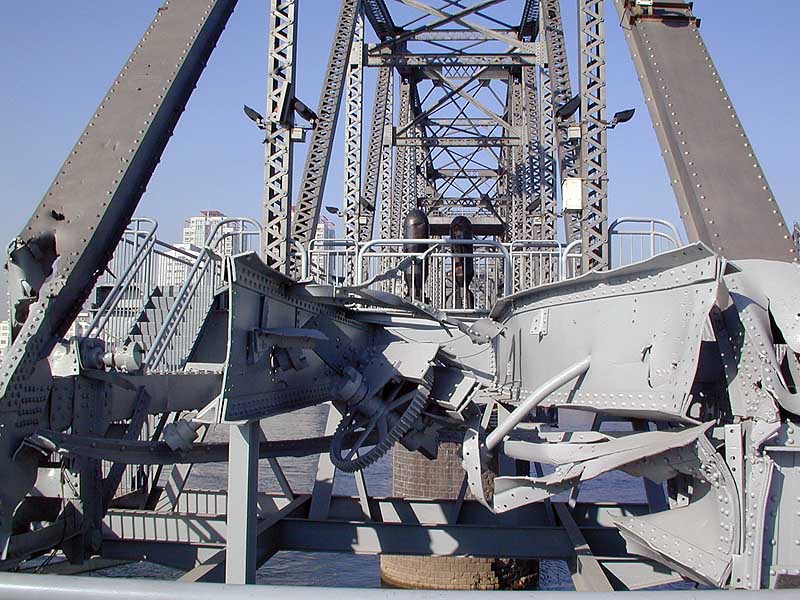


Sinuiju has a slightly smaller population than Dandong but at night it might as well not exist, it's absolutely invisible. At night Dandong is alive with lights, cars and people on the streets or in their electrically lit homes living their lives. At night Sinuiju appears to be dead, maybe the Dear Leader sucked the life out of it. I saw no lights at all except what appeared to be somebody welding. I did see some diffused light off in the distance, I’ve since read that it’s the statue of the Great Leader Kim Il Sung which has the only artificial light in town.
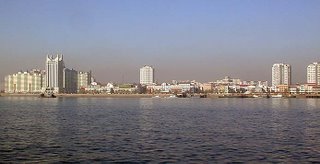
Directly above and below is Dandong as seen from a boat on the North Korean side of the Yalu. It's so prosperous it even has air pollution.
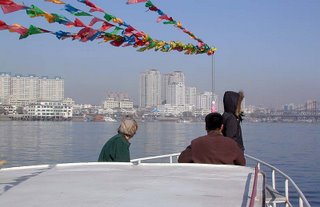
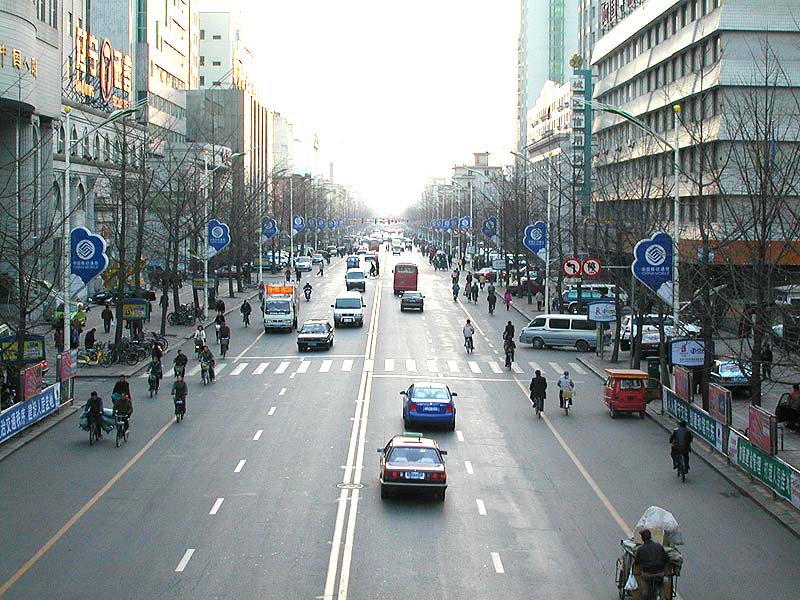
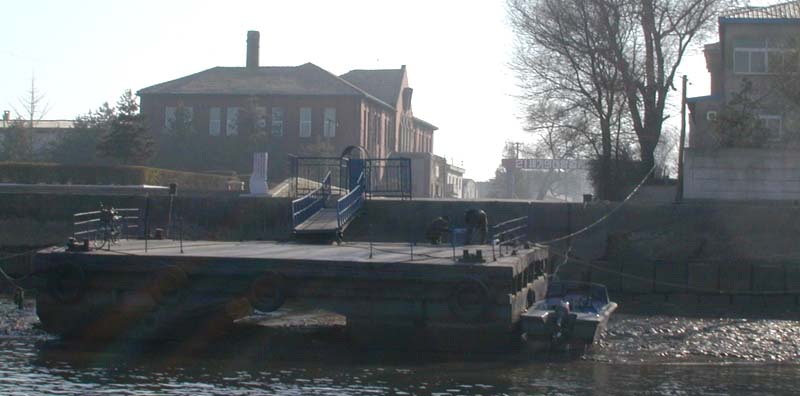

There's not much to see on the Sinuiju side of the Yalu. Plenty of rusting hulks, a few propaganda slogans (this one supposedly proclaims that Kim Jong Il is the light of the sun) and not much else. If rigid communism has any benefits they weren't evident from just offshore.
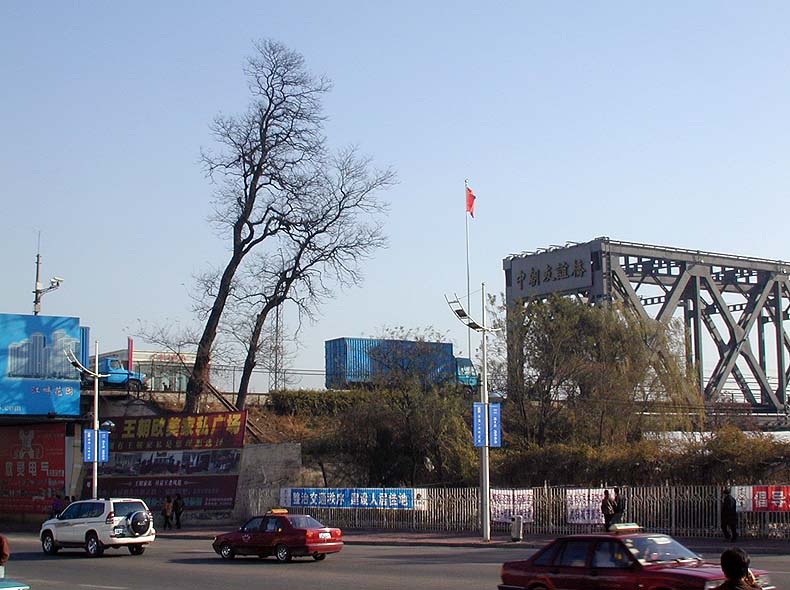
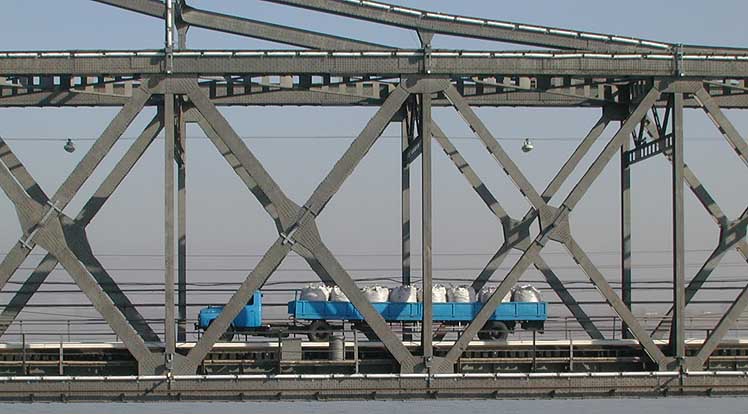
Truck traffic between Dandong and the DPRK. No clue on what's in the trucks. I saw carpeting heading into North Korea and a refrigerated truck from a Japanese meat company come out.
 The Great Helmsman bids you farewell.
 Sunday, September 10, 2006
Axis of Evil - Part 2
 When I was quite sure that I had seen all of North Korea that Dandong had to offer I remembered that Dandong is also the eastern terminus of the Great Wall. I certainly couldn't leave town without seeing the Great Wall so I asked the concierge at my 4 star hotel, the Zhonglian. Her English was passable, certainly better than my Mandarin but she had no idea what I was talking about. She called over a bellboy and they chatted in Mandarin about this strange laowai request. The bellboy also had no idea what I wanted. Temporarily defeated I retreated to my riverview room.
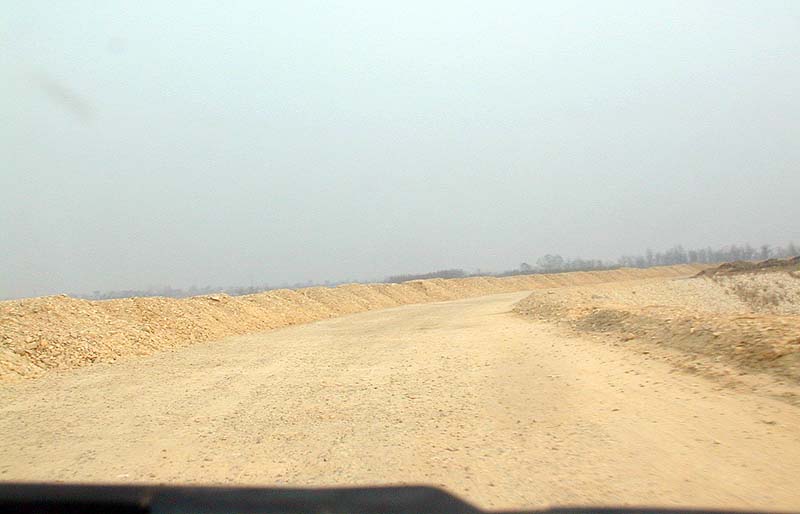
 Traveling with a laptop is puts the world at your fingers, even in China where the central government has the nasty habit of censoring the web. Some things on the web were conspicuous by their absence; some blogging sites were unreachable as was the cache option at google.com. A little research revealed that in these parts the Wall was referred to as Great Wall at Tiger Mountain. I returned to the concierge with my rephrased request. She still had no idea what I was talking about. But the English speaking bellboy did. "Oh, Great Wall!", he exclaimed. He explained it all to the concierge. I had them arrange for a taxi to take me there. They told me that it would cost 130 Yuan. They didn’t seem to recognize the term “round trip” so I didn’t know whether the driver would just abandon me out there or not. She wrote my destination for me in Chinese, the bellboy summoned a cab and I was off to the Great Wall. If I worked for a government entity with a world famous attraction in my jurisdiction one of the first things I’d do is make sure that the road from the biggest city around to the attraction was paved. Once my driver and I left the Dandong 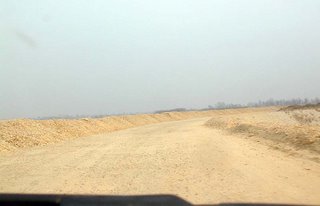
Admission to the tourist zone cost me another 30 Yuan; I passed on paying for admission to the
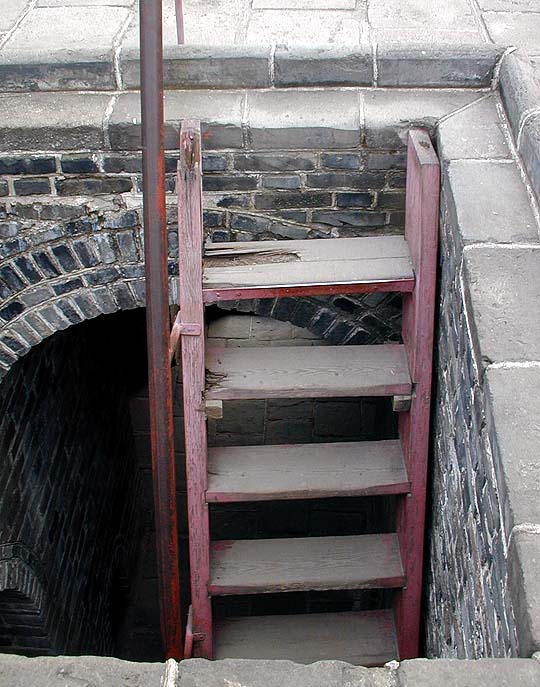
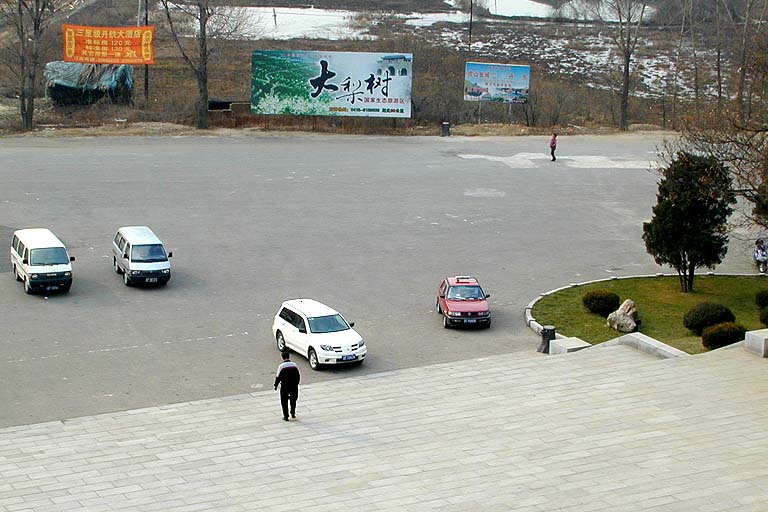
Above: my driver walks back to his red cab. The parking lot was almost empty OK, so the place needed some work. But this is the Great Wall of China! I looked around, it seemed that I had the whole place to myself. But I didn't want to let that cab out of my sight. But there was still plenty to see.

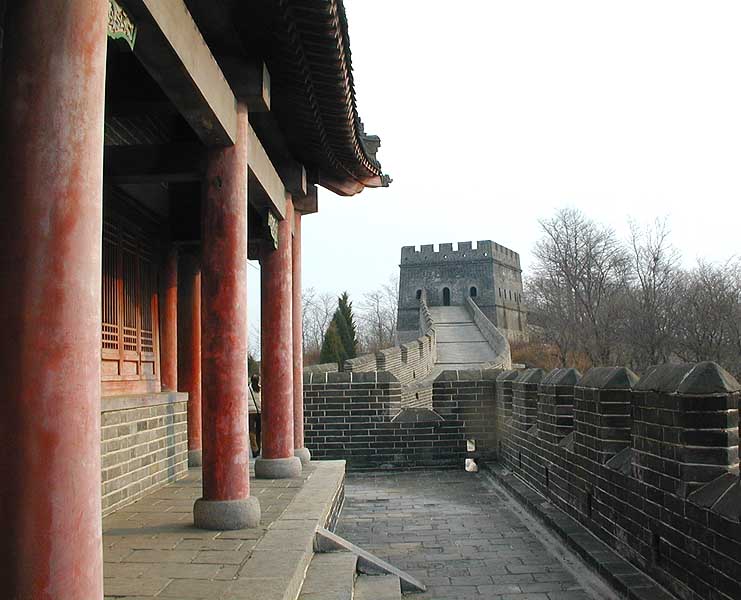
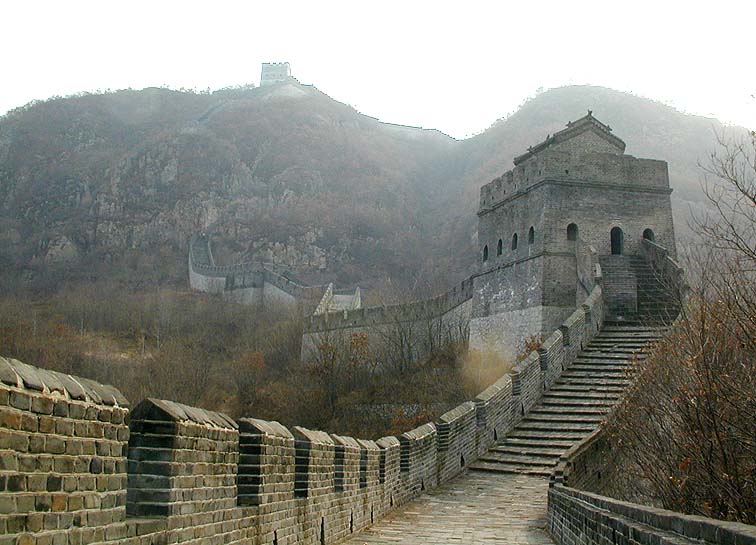
When I got back to the entrance my driver was still there, smoking a cigarette and listening to the radio. He looked at me and asked , “Choson?”, pronounced in a fast bark, Chow-sien. I already knew that the word Choson meant North Korea and thanks to the Internet I knew that the border in this area was just a small creek; perhaps he was offering to show it to me.
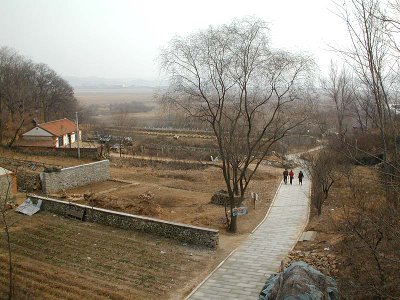

He took me to the creek that forms the border between China and the DPRK and pointed out 2 armed soldiers from the Korean People’s Army in the distance. He started to shout and wave at them. At first they ignored him but they soon started walking our way with their rifles slung over their shoulders. When they got closer a woman selling tourist nick-nacks from a cart indicated that I should buy a carton of cigarettes from her (around $6 US) and throw them across the creek. The soldiers asked who I was, the driver replied that I was an American. The woman indicated that now was the time for me to hurl the carton of smokes into North Korea. I hit the shore with the carton, the soldiers pretended not to notice. But when I lifted my camera up to my eye to get the shot they noticed that and protested loudly. When they walked away without the carton the woman who sold me the cigarettes gestured that it was alright to take a picture. I had read that the soldiers would come back for the cigarettes when there was no one around. So that’s 1/3 of the Axis of Evil. I didn’t see any actual evil on either my boat buzz of Sinuiju or my encounter with the KPA but perhaps the Kim family is keeping their reservoir of evil someplace else where I couldn’t see it.

Subscribe to:
Posts (Atom)