Sunday, November 18, 2007

Pantomine

One problem with seat of the pants wandering around lost tourism is it’s for the young and I ain’t so young anymore. All this wandering around has left me flu-ish and with sore, blistered feet. So I headed back to the drug store, a place I’ll probably be turning to with greater frequency as I age. Maybe I could score some Dr Scholl’s blister pads and keep on keepin’ on. How to explain the problem? Chinese drug stores are divided into two distinct sections with a walled divider. One part of the store is usually full of patrons, it’s the part that's solely concerned with selling soap, shampoos and cosmetics.

At times it has seemed to me that half of the female population of China is employed selling clothes, fashion accessories and cosmetics to the other half. Condoms are available on both sides of the drug store wall (my favorite Chinese condom brand names: "Jissbon" and "Six-Sex"). I've yet to see a male employed in either half of a Chinese drug store. On the side of the drug store wall where actual drugs are sold are prescription drugs, over the counter drugs (conveniently labeled "OTC") and Chinese herbal remedies. I was met on the drug store side of the drug store by three female clerks. I grabbed my left foot and said, "Ow, ow!". All three hit me with rapid fire Chinese, not a word of which did I understand. I shrugged my shoulders, pointed to my left foot and held out my left pinkie finger. My smallest toe is the one giving me the biggest grief. More Chinese, no understanding. I held out my left pinkie and pantomimed wrapping it with tape.

With that I got through. One clerk took me to the part of the store where they sold adhesive tape and band-aids. There's a business opportunity in China for the Dr Scholl company. After choosing my purchases I returned to the front of the store, where upon entering I had seen a display for Viagra. It would be a shame to come all this way and go home not knowing how much OTC Viagra costs. How much? A single dose is Y125. That's just under $17 US. But like everything else in this newly capitalist world there's a discount for buying in bulk. Party time? A box of 5 Viagra tablets sets you back a cool Y499, that's around $67 US. When I popped my eyes at the price one of the clerks brought me something cheaper, some kind of kangaroo extract. I laughed. The clerks laughed. Oh, so how did my purchase work out? Tape or no tape, my toe still hurts.

Guiyang People's Square: Wal*Mart & Mao


This picture shows the state of Communism in China today in a nutshell.  It’s so illustrative that it was stolen from my Flickr page and used without attribution or permission by an anti Wal-Mart website called Wal-Mart Watch.  So much for copyright protection.

This is People's Square in Guiyang. Off to the left and out of camera range there's the omnipresent giant Mao statue. On the other side of People's Square is a large mural showing the Forbidden City in Beijing, if you look closely in this picture you can make out Mao and Deng Xiao Ping, communist party heavy hitters of a bygone and failed era. People's Square has been hollowed out, what lives below People's Square in Guiyang is the largest, most densely packed, Wal-Mart Supercenter I've ever seen.

This is mid November and Christmas at Wal-Mart in China is in full swing. Right under Mao's atheist feet the store has plenty of fake Christmas trees and patrons are bathed in Christmas music, both secular and religious. It's doubtful that any of the patrons understand the lyrics but still, Bentonville would be up to its eyeballs in lawsuits and elitist complaints if Wal-Mart played hymns about the Virgin Mary in their US stores.
Communism stumbled on from 1949 until Den Xiao Ping wised up in 1979 impoverishing and stunting lives in China. The Communist Party and Mao and never give the Chinese people what Wal-Mart and Sam Walton give them every day: variety and low prices with no shortages or rationing. Communism in China couldn't put food on the table, millions died in famines that swept this country in the 1950's thanks to Mao and his state planning comrade geniuses. Political power might flow from the barrel of a gun but Wal-Mart stacks 'em deep and sells 'em cheap. You can't eat or wear the revolution.
Here's the Wal-Mart Supercenter in Kunming:


Update: If you run an trekking outfit in Nepal don't bother to post your ad here.  I will delete the spam that you repeatedly place here so fast that K2 will melt.  If you'd like to place an advertisement please contact Google and they can run your ads anywhere you'd like.  

Friday, November 16, 2007

Chairman Mao's Revenge

This picture was lots funnier yesterday, before I ate or came down with something that might make me a patient. And how fortunate for me, it's only a mile or so from my hotel here in Guiyang. Supposedly the outdoor night market down the block prepares a mean dog but I didn't (knowingly) sample any fillet of Fido or rack of Rover. I had some airline food on my way to a layover in Changsha. The flight attendants gave out little boxes of, well, I'm not entirely sure what was in there. The flight attendant said, "noodle" and it appeared to be wispy noodles with flecks of meat.

In China meat often means pork and not only don't I eat red meat I also watch what I eat very carefully here in China. But I let my guard down and scarfed down the greasy noodles. A guy's got to eat and my problem here in China is: would I rather not know what's on the Mandarin only menu or would I prefer a menu in English? Actually, that menu would be in "English", the last one I encountered in Xiamen used delectable descriptors that I never want to see on a restaurant menu again such as "Worms" and "Clam grease". This dilemma usually sends me to the supermarket. I can't read the labels there either but I know a loaf or bread or a container of sweet corn yogurt when I see one.

When I got off the plane in Guiyang my stomach and other connected organs had formed a chorus of, "Hey! Pay attention to us! Do It Now!". So after checking in I headed to the Beijing Hualian supermarket chain around the corner and bought a 2 liter jug of purified water. I'm sure that's what the label would've said in English. The label had Chinese characters and a picture of a polar bear. Oh, I also bought some already peeled fruit. Mandarin oranges, pieces of Dragon Fruit, melon, apple and maybe a little Ecoli. And maybe some melamine. There was no label and even if there was, I couldn't read it anyway.

So I was up all night pouring water into the top end of me and, well, you get the picture. Up all night wondering what I was thinking in coming here to China. Wanting to be home in my own bed, using my own toothbrush and if I had to be sick sitting on my very own throne. But that's not an option now. I'm off to Kunming on Monday and Bangkok on next Saturday before I come home to Seattle and Eleanor's fantastic and creative cooking. Mmmmm.

Next stop today was a drug store. I needed to stock up on over the counter meds like Imodium (Loperamide). There's a local drug store chain across the square, surely they'd have something for what ails me. I walked in and was met by a pretty clerk with an enquiring, helpful look. I patted my stomach and made a face. I patted my behind. I showed her my last remaining Loperamide tablet. She giggled and took me right over to the Viagra display.

Wednesday, November 14, 2007

Nanjing Subway Train

Nanjing has gotten the better of me. The language barrier is just too thick and the city is just too vast.

I easily mastered riding the Nanjing Metro. The token machines have an option labeled “English”, just put in Y2, grab a plastic token and tap on a designated strip on the turnstile and you’re in. The stops are labeled in English too. As a form of sheer, brute force tourism I tried just getting off at stops at random and walking around whatever neighborhoods I happened upon. Most of them didn’t have much to offer except stares from the few locals so all I got for my efforts were sore feet. The air in Nanjing is awful. The weather forecasts have called for partly sunny but the rays of old Sol never make it past all of the particulates suspended in the air. The sky here is gray, visibility is severely limited. The air smells like concrete and it probably is concrete too. It can’t be conducive to good health to breathe here but the locals do it and many compound it and smoke cigarettes too. Then again, if the air here doesn’t get ya the local drivers will.

I’m batting 500 on my attempt to take cabs here. My attempt to take a cab to Carrefour last night went perfectly. An available cab drove down the sidewalk (!) and I showed the driver my slip of paper and got in. My attempt to visit a famous huge bridge over the Yangtze was a bust though. Every cabbie I showed my slip of paper too shook his head and gave me a funny look, like I had recited the Gettysburg address backward.

I was at a Metro station and there were about 5 guys on motorcycles. They looked at my slip of paper and gestured to me that I get on the back of a bike. Riding on a motorcycle with Chinese strangers in Chinese traffic didn’t strike me as part of a healthy lifestyle so I patted the top of my head to indicate my lack of helmet. They had helmets, one of them offered to let me wear his. I still didn’t think that this was a great idea so I shook my head and walked away.

Tomorrow I move on. I had wanted to go to a warm city in the south, close to the Vietnamese border called Nanning but there are no seats on the plane so Nanning is a no go. So I've got to make due with next best, Guiyang. I'm thinking of staying in a higher end hotel, I need some of the soft life. Jin's Inn has been OK but it's a bit basic. The bed isn't much softer than the floor. I bought my plane ticket to Guiyang on line this morning, I'm supposed to pick it up at the airport tomorrow. Where at the airport is going to be another problem, here's the email from the company that sold me the ticket. Where do I pick up that ticket again Mandy???

Dear Sir,

Thank you for choosing eLong!

Regarding your reservation 12391623, you can pick up the ticket from the:

您的取票地址:机场2楼东航值机柜台东航万里行窗口

Your ticketing address:Eastern Airline's Counter (Wanlixing window), F2 of Terminal, Nanjing Airport

Best regards, Mandy English Team of Call Center eLong Inc. (NASDAQ: LONG) Tel: (8610)64329999 ext. 6 Fax: (8610)64311239 E-mail: abroad@corp.elong.com Address: 2F, Block B, Galaxy Plaza, 10 Jiuxianqiao Middle Road, Chaoyang District, Beijing 100016


Getting lost in Nanjing

Maybe my age is catching up with me. My dogs are barking. My feet hurt. I'm no stranger to walking in a big city but population wise Nanjing is 10 times the size of little Seattle and I can't read most of the signs. Oh sure, there are some signs in Roman letters but Nanjing's traffic department seems to use them sparingly. I spent today lost and hurting. This city is noisy. Driver honk their horns at everything that moves, including other vehicles. Lots of people here have scooters and they drive them wherever they wish. Sidewalk driving? No problem! The scooters also have burglar alarms. People park their scooters on the sidewalk with hundreds of other scooters. When one gets touched or a loud truck passes by all of their alarms go off together like a hospital nursery full of crying, screaming infants. There's construction everywhere; buildings, stores, a new subway line is going in a few blocks from my hotel and Chinese construction sites run two, maybe three shifts a day. It's loud, I'm lost. My feet are shouting, get the fsck off of us. NOW.

I set out this morning for the Memorial to the Victims of the Nanjing Massacre. One of my tour books had it written in Chinese but every time I showed it to a cab driver they shook their head and rattled something off that I didn't understand. I think it's closed for renovations. I really wanted to see it, in 1937 the Japanese Imperial Army took time out from their busy schedule of conquering most of Asia to make a special example of the City of Nanjing. In a few weeks of true Nazi league genocide 300,000 Nanjing locals were killed in mass murders, head chopping contests, mutilations. Countless women were gang raped by Japanese soldiers or pressed into sexual slavery in the service of the Japanese Imperial Army. Brutality and war go hand in hand but the Japanese went above and beyond in visiting suffering and misery on their conquered subjects here.

I tried walking to the memorial but my feet made me turn back. I went looking for a restaurant district instead, I couldn't find that either. So I came back to the hotel and had a bright idea. I called up a few web pages of places I wanted to see, pages with both Chinese and English. I took my laptop down to the front desk, showed the clerks the pages while I said "taxi" and few times and pantomimed writing. I think it worked, I'm about to go out into the loud night to find out.

Monday, November 12, 2007

Nanjing

It turns out the Nanjing airport is about 30 or 40 miles south of downtown. And my suitcase was delivered to me wet. Dry on the inside, wet on the outside. Wet with alcohol or some kind of non water based liquid (industrial solvent?) so at least it dried quickly. Outside were the usual collection of cabbies that hounded me but a few chants of "boo yao" (Mandarin for "don't want") dissolved them. A bus was loading, I paid Y25 and boarded. On the plane into Nanjing on China Eastern Airlines every announcement was bilingual, in spite of the fact that I appeared to be the only non Chinese passenger. China Eastern also ran a few informational videos during the flight instructing people to save energy and cut greenhouse gasses by buying compact florescent lighting and driving less. No mention of flying less though.

But all the announcements on the bus were strictly in rapid fire Mandarin and naturally I appeared to be the only non Mandarin speaker. And I had no way of checking if this bus was even going to Nanjing. But it did. And it started to drop off passengers who'd need to retrieve luggage in the big storage compartment under the seating area, often just stopping in a lane of traffic because in Chinese traffic size and might makes right. Eventually there were fewer and fewer people on the bus and finally I let myself out. I hailed a cab and showed the driver a piece of paper with my hotel placed on a map. He shook his head no, gave me back my map and drove away. The next cabbie studied the map and finally looked up, smiled and shouted, "OK". Within a few blocks he made a U-turn and then charged into a dark alley at top speed. Within a few blocks he stopped at my hotel, the Xinjiekou branch of a local chain called Jin's Inn. Schmuck's luck, I was close to my destination all along.

Please read: I'm heavily handcuffed in my blogging here in China. Blogger is mostly off limits from within China, I can't see my own blog. I can post pictures to my account in Flickr but I can only see my own pictures that I've uploaded from China. All other pictures on Flickr, even my own pictures, are blocked by the Great Firewall of China. I am able to do these rudimentary blog entries by telling Flickr that'd I'd like to base a post on Blogger on a particular picture. I can then edit in a small box on Flickr but can't see the final product on Blogger. It's kind of a 21st century Samizdat. Fun stuff so please forgive any layout faux pas.

Saturday, November 10, 2007

Getting Around in a Strange Land

Getting from place to place when you can't speak the language is exciting and frustrating. If someone can write my destination in the local language I grab a cab. If I'm on a long walk to nowhere in particular I make note of the bus route numbers and just like at home I grab public transit when I can. A ride on a bus here in Xiamen is only 1 RMB. Even with a sinking US dollar that's a little over 4 cents. Sure, the locals stare but they stare at me where ever I go.

Crossing the Street Chinese Style

Where am I? After nearly 24 hours on 3 different flights I finally got off the plane, went through customs and got into a cab. The cabbie cut off other cars, passed on the right, took a few cell phone calls, scattered some pedestrians and drove on the sidewalk. That’s right, I’m back in China! I’m in Xiamen, in Fujian province.

Sunday, May 06, 2007

Made in Japan

Before I went to Japan last Thanksgiving Eleanor asked me to get her some small single edged razor blades on a plastic stalk. I picked them up at a 7/11 in Tokyo. Before I went back in April I asked her if she needed any more. "No thanks", she said. I get them at Daiso now".

We have dollar stores, the Japanese have 100 Yen stores. Daiso is a 100 Yen store and it's starting to show up in North America on the west coast from Richmond, BC to the Bay Area. For me the great thing about that is that it's mostly unchanged from a Daiso store in Tokyo. Most items for sale are $1.50 or $2 and most of the products are packaged exactly the way they are in Japan, in either Japanese or Engrish or both. In many cases if you don't know kanji you don't know what's in the package.

Some of the products have cultural problems. Before I went to Japan in April I stopped off at the Daiso store in Seattle (Westlake, there's another one at the Alderwood Mall) and bought some vacuum travel bags. You put your clothes in the bag, roll the air out and seal them up for a tight pack and extra luggage space. They had a bag for sale that seemed to be for underwear, the pictures showed underwear and bras going into a blue bag. When I got them home I discovered that these bags weren't fit for Bubba's britches, by American standards these bags were large blue sandwich bags. But Daiso has all sorts of Japanese cleaning supplies, cheap tools, kitchen ware. Much of the stuff is made in China for the Japanese market.

Daiso seems to have been careful to filter out many of the home market products that would have no use here but a few got through. I caught their store in downtown Seattle selling little learners signs to hang from the left rear mudflap of as car. The packaging implied that these were mandatory for new drivers. They might be there but not here. They were also selling cheap cell phone headsets. That's fine but Japanese cell phone headset connectors all seem to adhere to a Japanese standard, one that isn't used on US market phones. But many products survive their trip across the Pacific with their Engrish intact, here's a small car bag for the car that I bought at Daiso for $1.50.

When I travel overseas I love to hit the local stores. Hands down one of the best stores I've found is Tokyu Hands. I dropped a few hundred dollars there and would go back tomorrow if I could. Tokyu Hands is what Home Depot and Lowes want to be when they grow up. In Tokyu Hands I bought a replacement knob for the lid of my old Hitachi rice cooker (the original knob was cheap and had long ago stripped), some gorgeous ergonomic screwdrivers (Made by Vessel, I paid extra for the tang-thru), a pair of pliers made by a company named Lobster and another set of pliers with replaceable plastic jaw liners - pliers with a soft touch. The Japanese have a gadget for every real or imagined need so when I saw this simple tool for recycling I knew I had be the first on my block to own one. It's great! I also scored a small hand saw for yard work. In Japan it's sold as the XBeam but the US arm of Tagaki Tools or their importer changed the name here to Shark Corporation and the name of the saw to Yardshark. It looks like Crocodile Dundee's jack knife. Boy, does it ever chew through wood. Nowhere in this post have I said that anything I bought in Japan was cheap. Buying anything in Japan is never cheap, at least not by US norms. But shopping in Japan makes up in innovation and selection what it looses in price.

Friday, April 06, 2007

On the Ground in Tokyo. Again

It’s too bad that I don’t get to stay in Asia long enough to learn to not offend the sensitivity of the locals. I got off on the wrong foot right away by boarding the train to town from Narita Airport. It had just come into the station. It was the last stop and everyone on board got off so I got on. And was promptly asked to leave by the cleaning lady. It seems that the train is entirely cleaned after every run. I also can never remember to not offend cashiers in Japan. Here in Japan when one pay one is never supposed to place money into a cashier’s hand. That’s why they have a small tray, hands should never touch. I always forget this like the dumb gaijin that I am. Today I found a new way to play dumb foreigner. I had retained a 160Y subway ticket from my last trip here back in late November 2006. I had read that tickets were good for 6 months. Maybe not, when I tried to exit a station the turnstile refused to let me pass and politely told me to see an attendant. I handed in my delinquent ticket where they guys behind the desk immediately noticed how stale it was. I showed them my new Suica stored value card, it’s much like the Octopus card in Hong Kong and it’s new in Tokyo. With typical Japanese efficiency they took my Suica card, deducted 160Y and sent me on my way to get lost again. I spent much of the day hopping from subway line to train line in a futile effort not to be lost. I was trying to get from Shinjuku to Akihabara but theTokyo Metro Map looks like the floor after somebody dropped a pot of ramen. Anybody who knows me knows that I’m colorblind and even in English some of the stations and lines overlap so I never knew where I was going. My Suica card took a beating today. I think I’m just going to drain it at a 7/11 and tomorrow I’ll just buy an all day pass. But that may not work since Tokyo Metro runs maybe half the train lines, the others (JR, Toei) seem to be private or belong to some other municipal or prefectural agency. They all seem to take my Suica though. Because Blogger knows I'm in Japan it insists on giving me a Japanese interface. That’s why it took a month for this page to appear, I couldn’t find the Kanji equivalent of >Publish< on Blogger. But better late than never here are pictures from this whirlwind trip. Great views of Tokyo from the Tokyo Tower.

Sunday, December 10, 2006

All Hail Toyota!

Sell your GM stock, they’re doomed. Ford too. When I was in Tokyo I visited the Amlux Toyota Showroom, a 4 floor showcase of everything Toyota sells in Japan. It’s a full house. It’s no secret that Toyota is stomping domestic rivals in North America. But now I see that in the North American market Toyota is playing with one hand tied behind it’s back. In Japan they sell everything from a small scooter to the Toyota Century, it lists for close to $100,000. They sell more different kinds of SUV’s in Japan then they do in the US and their US lineup is fat with SUV’s. In Japan Toyota sells small cars, large cars, even a small car with a passenger seat that doubles as a wheelchair. Great looking Toyotas with goofy Japanese car names like Alphard, Ipsum, Passo, Fielder, Ractis, Wish, Brevis, Progres (not a typo), Rush, and Spacio. All this in a small country where gasoline costs close to $5 for a US gallon. Although I saw a Japanese made Camry at the Amlux Showroom I don’t think I saw one on the streets of Tokyo. It’s commonly accepted that Japan is a small country with expensive gasoline and the Japanese drive small cars. Some do but I saw plenty of big cars, both Japanese and European, plying the streets of Tokyo. There was no shortage of large Mercedes, Audis and BMWs, even big expensive ones. I did see one Chevrolet Suburban in a parking spot on a Tokyo street and there was overhang of the marked parking space both front and rear. Another surprise was the small number of Priuses (Priii?) I saw on the streets of Tokyo. I saw some but it doesn’t seem to be the statement of fashion, environmental righteousness and virtue in Japan that Prius ownership implies in the US where gasoline costs half as much as it does in Japan. From what I sawToyota pretty much dominates the market. They have a car for every market niche and if market conditions in North America change Toyota will be waiting.

Wednesday, November 29, 2006

Tuesday, November 28, 2006

Putting the Toothpaste Back Into the Tube

I wrote this on the flight from Narita to Seattle. And so it’s over. For now. Time to mentally put the toothpaste back into the tube, go home, put the ring back into my nose and get back to my same old used to be. Back to responsibilities of work and home ownership and being a 21st century civilized adult male. Oy! If I’ve learned one thing on these recent overseas trips it’s that age brings more impairment than wisdom. My feet hurt. I’m tired. No, I’m exhausted. And my feet hurt. They ache in that kind of needing to have them soaked and massaged kind of way that I’ve never experienced before. Instead of feeling my oats I’m feeling my age. I’m still not sorry that I go to a foreign countries and hit the streets brute force solo. But I fear that soon I’ll have a bigger appetite for overseas travel than my feet can carry. Asia is still calling me. I don’t know why but it still does. And I don’t want to answer that call from a window seat on a tour bus, I don’t want to be spoon fed. The only time I’ve ever taken an organized tour was back in 1984 when I went to Guangzhou because the xenophobic ChiCom (Chinese communist) government of the day said that tours were mandatory for American citizens, no solo travel was allowed. Will I go back to Asia and do it my way again? Hell yes. While I still can.

Saturday, November 25, 2006

Friday, November 24, 2006

Akihabara and Christmas

Akihabara (or Akiba) is the well known Tokyo geek neighborhood. It’s home to gizmo, tool, electrical supply, manga and anime shops. For me it was must see JP. While there’s plenty of selection in Akihabara the prices are high, maybe 30% higher to someone used to shopping at Costco, New Egg and EBay in the US. It’s either a happy coincidence or price fixing but prices are pretty much the same from shop to shop. Whatever it’s failings the USA is a shoppers paradise. But that doesn’t mean that I didn’t score anything in Akihabara. I couldn’t leave without a USB coffee warmer and a USB fan. No sign of the elusive USB butt warmer or USB butt cooler but maybe my shopping techniques are more set to shop but not to drop. I know that they’re out there somewhere in Tokyo because just about everything electronic and is. Japan’s industry is world famous for good reason. And Japan was well built with Japanese made precision tough tools. With so many lousy tools on the market back home I bought several Vessel screwdrivers. I also scored a few electrical plugs and connectors that are made for tight and/or angle installations, Home Depot and Lowes carry crap. I steered clear of the anime and manga shops. I peeked into a few and saw a staple of Japanese men, soft core pr0n comic books. I had heard that some of the women handing out flyers on the main drag of Akiba, Chuo-Dori, were dressed as French maids. It’s true but I have no idea why. One of the French maids I saw was handing out flyers for a restaurant called Melty Burger. The Japanese seem to borrow freely from other cultures. Americans borrow too but in the USA it’s because we’re borrowing from people who brought their culture to our culture when they came to the US and it gets smushed together somehow in the diversity we always hear about. Not so in Japan, aside from African and other exotic prostitutes the country is pretty much closed off from the immigration and melting pot ways of the USA. Japan is a homogeneous country, just about everybody here is Japanese. There’s a small Korean minority and the Japanese supposedly don’t let the Koreans forget who’s number one (and it's not the Koreans). So the Japanese are free to pick and chose whatever cultural elements they want, often from TV, and to interpret it any way they want. How they interpret a teenager in a frilly French maid’s outfit handing out flyers for a restaurant is beyond me, please email me with any suggestions. The Japanese have also adopted Christmas. It’s Christmas Jim, but not as we know it. For one thing, except for a small minority there’s no Christ in Japanese Christmas. Never had it, probably never will. But they go nuts with gift giving and trees, ornaments, ribbons, tinsel, Santa Claus and many of the usual trappings of the season. TV this morning was wall to wall with live shots of Christmas lights in Los Angeles and the Macy's Thanksgiving parade in New York. This year a special guest will be showing up in Tokyo, one who loves little children and knows what they want in the true spirit of the season. Michael Jackson is coming to town. Just because it has no religious significance doesn’t mean that stores treat it any differently here. At least in the US we pretend that the holiday is grounded in religion. Sometimes. But in Japan they don't even pretend. Stores play wall to wall Christmas music, some of it with quite religious lyrics. Since most of the population has no idea what the words mean the religion in some of the songs means nothing to them. Maybe the Japanese have more in common with we Americans than I originally thought.

Thursday, November 23, 2006

Morning Coffee Tokyo Style

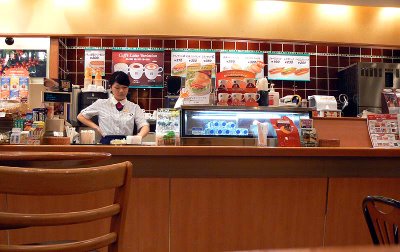
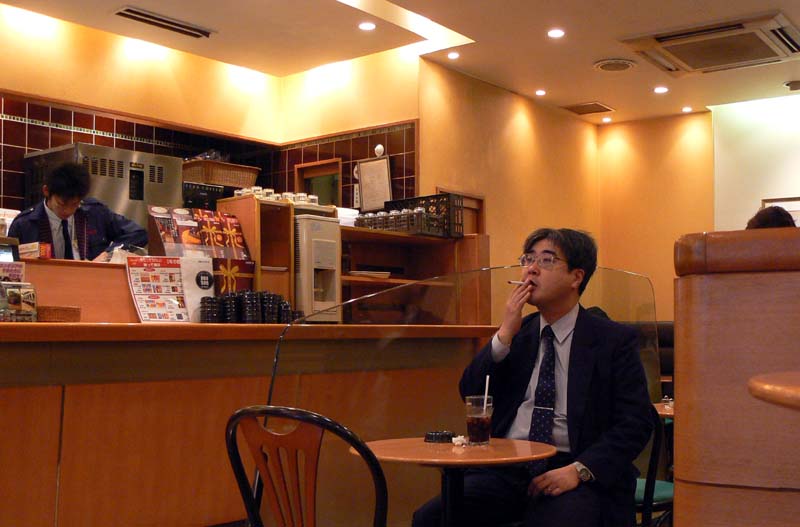
This is a Doutor Coffee shop. One difference from home is that coffee shops don't open until 7am in Tokyo. Another difference is that smoking is just fine in some coffee shops in Tokyo, smokers doesn't seem to carry the social stigma that they do in the US. You can light up nearly anywhere here without getting nasty looks or being considered a pariah. I sat down with my small cup of coffee ($2.20 US) and smelled cigarettes. The salaryman next to me was puffing away. And so was everybody else. The only person in the place who seemed to give this activity more than a passing thought was me.

One woman who appeared to be in her early twenties walked in wearing a surgical mask. Many people here do so that wasn't all that unusual. She ordered her drink, sat down, pulled the mask down exposing her mouth and instead of sipping her drink she lit up and began to puff away. So I guess that not everybody here who wears a surgical mask in public does it for health concerns, maybe it's just a fashion statement.

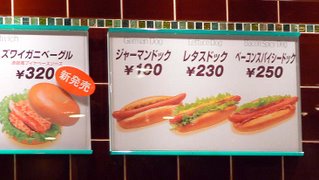
Mmmm, German Dog, Lettuce Dog and Bacon Spicy Dog.
Tokyo - Arrived

Greetings from Tokyo. My hotel room may be the size of a closet but it has Internet access and one of those squirting electric "washlets".
To go or not to go, that is the question. But first I'd have to eat something and so far the food looks kinda strange. I got in late and it's raining. Good thing that there's a 7-11 near my hotel. 7-11's and nearly identical convenience stores are everywhere, at least in this neighborhood (Nihombashi). I bought some food (I have no idea what) at the 7-11, I don't think I'll ever get used to having the cashier at the 7-11 bow. The hotel clerk who checked me in also bowed. I have a feeling that there will be more bowing in my immediate future Tokyo is neat and orderly. I could see it while the plane was still in the air, in parking lots cars were parked neatly with exactly the same amount of space surrounding them. The roads were orderly. Every time I've flown in the states in the last few years people whipped out their cell phones the minute the wheels touched the ground. Not so when my plane landed. I walked around for an hour or 2 and have yet to hear a car horn. The train from Narita airport had signs on the windows telling people not to use their cell phones and I heard nobody disregarding that request. There was lots of texting going on though. Bicycles are left in the street without locks, everybody waits for the WALK sign, nom matter how dead the traffic, people place wet umbrellas into holders outside of a store and know that the umbrella will be there when they return. This bears further investigation. But I've been up for nearly 24 hours, time to crash.

Tuesday, September 19, 2006

Pandamonium

After my breakfast of peppered peanuts and noodles I decided to head out to the Chengdu Panda Research station, just outside of town. My map said that the 302 city bus would do the job. The man at the hotel front desk who spoke some English said that I'd need to take 2 buses just to get to the 302. He wrote it all out for me but I decided that I'd be lost forever and maybe even crushed and steamed, those buses look awfully hot and packed. Some of the Chengdu buses say "City Boat" on them, others "City Bus". I don't get it. I'm all for public transportation but in China I can't read, write or speak and that makes public transportation a big problem. Besides, taxis in China are cheap. So I took a taxi. Driving in China is like the Chinese language, it's based on a philosophy that I just don't understand. And like the Chinese language Chinese driving works, sort of. The last time I was here I was in province and I didn't see a stop sign. Chengdu has stop signs but I might be the only one who's noticed them. Moving obstacles, either other cars or people are avoided in a kind of mechanized ballet that looks deadly to me, because I don't understand it. We dodged pedestrians and trucks and buses, nothing unusual for China. My driver was yacking on his cell phone when he cut off a cop. No problemo, the cop had been yacking on his cell phone too and may not have noticed. On the way I saw 3 wheeled trucks and some guy hauling large slabs of meaty ribs piled onto the back of his bicycle. Chinese driver lay on the horn so much that it's just background noise now and some drivers have taken it to the next level by installing incredibly loud truck horns in their cars. How bad is the driving? This morning when I walked in on the local TV news in the hotel's dining area they were showing a scene of burning devastation. News from Iraq? No, some awful traffic accident that involved trucks, cars, motorcycles, bicycles and burning store fronts. Vehicular safety here must be in its infancy with no Communist Party version of Ralph Nader to prod it along. I've only seen one motorcyclist wearing a helmet, he was a cop. Kids riding as passengers on bicycles sometimes stand up and hold on to the driver for balance. In the US their parents would kill them, in China their parents are pedaling the bicycle. The panda has some problems. Their habitat has been encroached upon by China's 1.3 billion citizens. Pandas are finicky eaters too, they eat only several species of bamboo. They have a reproductive problem too. How can I put this gently, if male pandas had email they'd be awash in spam claiming the ability to help them. Male pandas just don't get the job done. But the panda has an ace up it's sleeve, it's cute and we as a species love cute animals. The panda is a bear but he's given up the eating of meat for a peaceful life of chomping bamboo, lots of bamboo. But they still have big jaws (bamboo is incredibly strong stuff) and big claws and they don't call them Giant Pandas for nothing. The red panda is so small I thought it was a fox. But it's a shrunken bear that's very endangered. More about the Chengdu research facility and pandas here: http://www.panda.org.cn/english/eindex.htm

Thursday, September 14, 2006

Axis of Evil - Part 1

Dandong - Mao

That's Chairman Mao himself outside of the train station in Dandong. When I decided to focus much of my travel on China I knew that a must see destination would be the northeastern city of Dandong. I wanted to get as close as an American citizen can to Asia’s founding member of the “Axis of Evil”, North Korea. I’ve long been fascinated with the Democratic People’s Republic of Korea or DPRK. The DPRK has been described as a Stalinist Theme Park. If the communism in today’s China can be described as Communism Lite, the DPRK is old school Commie Classic. Stalin’s USSR had no cell phones and neither does the DPRK, they’re banned. Electricity is a sometimes thing as is food. After a bad harvest a few years ago and resulting famine that claimed hundreds of thousands of lives one of the government’s slogans was, “Let’s all eat 2 meals a day”. Anyone with a fast Internet connection can watch canned broadcasts of the nightly news from Pyongyang (http://www.elufa.net/) and understanding Korean isn’t a requirement to notice that things are just a wee bit odd in the DPRK. Since the DPRK is a one party state ruled by the Korean Workers Party and the head of the party, Kim Jong Il, is known as the “Dear Leader” most of the news is about his comings and goings, such as his visits to army bases or to collective farms to dispense “on the spot guidance” and tell farmers in person what they ought to grow or not grow. Or the historic comings and goings of his father Kim Il Sung, the “Great Leader” because the DPRK is the world’s first communist dynasty. In the dead of winter the news often shows office workers in winter coats and vapor streaming from their mouths because in the energy poor DPRK if it’s cold outside it’s cold inside. Does a rocky hillside have to be moved in preparation for new construction? No problem because although the DPRK lacks modern earth moving equipment I’ve seen workers on TV breaking big ones into little ones with sledge hammers and chisels while others dutifully carry off the debris in baskets. I’d love to go and see all this for myself but there are several obstacles:

  • American citizens are forbidden entry because although there's an armistice the US and DPRK are still technically at war.
  • Tourists that do make it into the DPRK are assigned minders and their itineraries are set by the government, wandering off alone and mingling with the locals is strictly prohibited.

  • Why give money to to aid and strengthen brutal dictators? We’re not talking Gitmo here. Read the Aquariums of Pyongyang; if you don’t catch snakes, lizards, rats and insects to eat while you’re in a North Korean labor camp you die of starvation. After a day of forced mining or logging committing the speeches of the ruling Kim clan to memory is mandatory.

OK, so I couldn't enter the country but I could get up close and peer in. To do so I had to go to Dandong. Dandong is on the Yalu River in Liaoning province and was once a staging ground for Chinese “volunteers” who fought in the Korean War against the US. Today there’s a museum there with the pretentious cold war name of Museum Commemorating the War to Resist American Aggression and Aid Korea.

Dandong is a Seattle sized city of roughly 500,000 people and is the eastern terminus of the Great Wall of China. The Yalu River forms the border between China and the DPRK, right across the Yalu is the North Korean city of Sinuiju. I booked a "Riverview" room at Dandong’s only 4 star hotel, the Zhonglian, a room with a view, a view of North Korea. Dandong on the Yalu: Hotel view

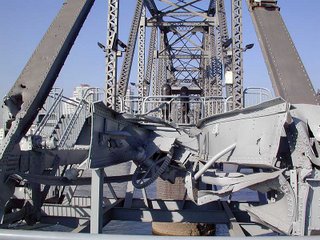
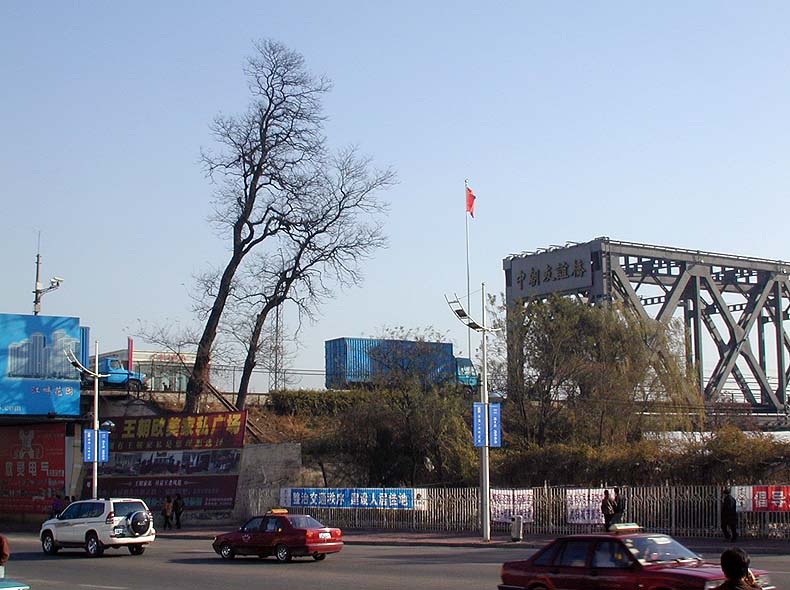
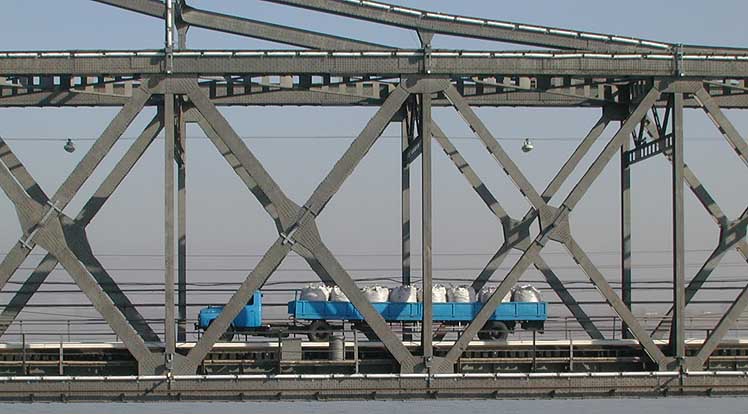
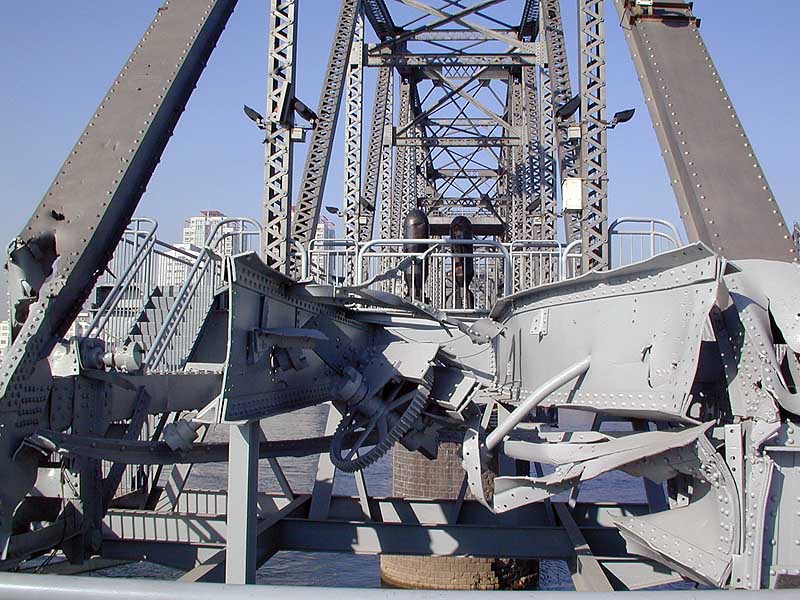
See those 2 bridges that my riverview room looked out on? Actually it’s just a bridge and a half. The austere bridge on the left connects Dandong and Sinuiju with one reversible lane for motor vehicles and one railroad track. The half bridge on the right was built during the Japanese occupation of Manchuria and was bombed during the Korean war by the US Air Force in 1950 and was never rebuilt. On the DPRK side only the footings remain. Today the “Broken Bridge” is a tourist attraction, admission 20 Yuan. My admission ticket is below.

 Bridge mangled 3

Sinuiju has a slightly smaller population than Dandong but at night it might as well not exist, it's absolutely invisible. At night Dandong is alive with lights, cars and people on the streets or in their electrically lit homes living their lives. At night Sinuiju appears to be dead, maybe the Dear Leader sucked the life out of it. I saw no lights at all except what appeared to be somebody welding. I did see some diffused light off in the distance, I’ve since read that it’s the statue of the Great Leader Kim Il Sung which has the only artificial light in town.

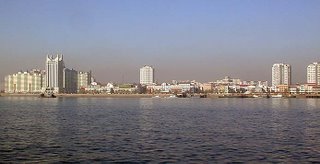
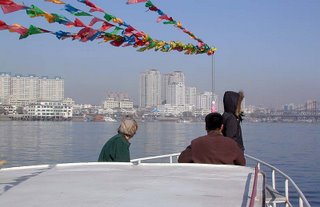
Directly above and below is Dandong as seen from a boat on the North Korean side of the Yalu. It's so prosperous it even has air pollution.


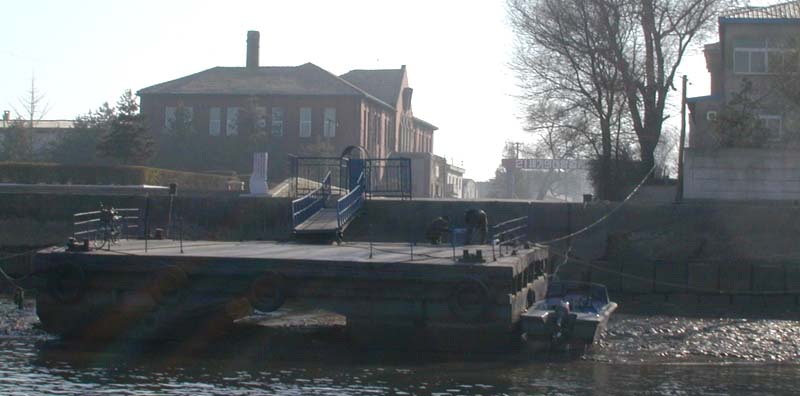
There's not much to see on the Sinuiju side of the Yalu. Plenty of rusting hulks, a few propaganda slogans (this one supposedly proclaims that Kim Jong Il is the light of the sun) and not much else. If rigid communism has any benefits they weren't evident from just offshore.

Truck traffic between Dandong and the DPRK. No clue on what's in the trucks. I saw carpeting heading into North Korea and a refrigerated truck from a Japanese meat company come out.
The Great Helmsman bids you farewell.

Sunday, September 10, 2006

Axis of Evil - Part 2

When I was quite sure that I had seen all of North Korea that Dandong had to offer I remembered that Dandong is also the eastern terminus of the Great Wall. I certainly couldn't leave town without seeing the Great Wall so I asked the concierge at my 4 star hotel, the Zhonglian. Her English was passable, certainly better than my Mandarin but she had no idea what I was talking about. She called over a bellboy and they chatted in Mandarin about this strange laowai request. The bellboy also had no idea what I wanted. Temporarily defeated I retreated to my riverview room.
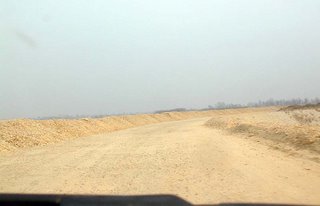
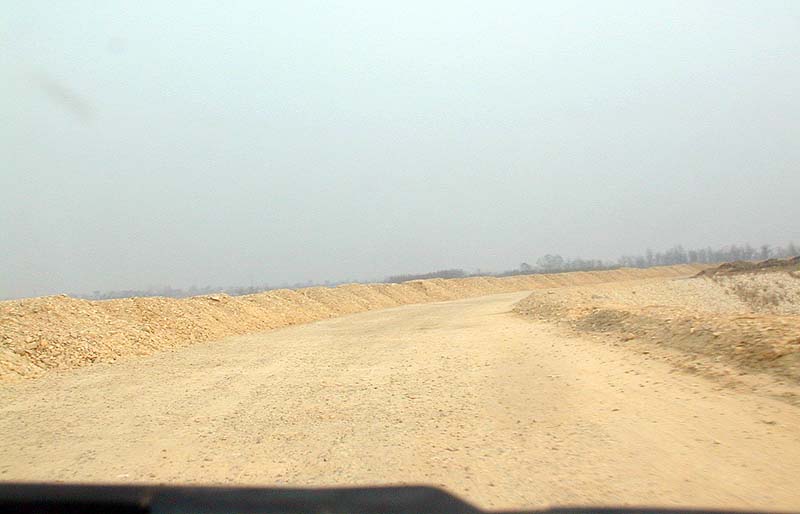
Traveling with a laptop is puts the world at your fingers, even in China where the central government has the nasty habit of censoring the web. Some things on the web were conspicuous by their absence; some blogging sites were unreachable as was the cache option at google.com. A little research revealed that in these parts the Wall was referred to as Great Wall at Tiger Mountain. I returned to the concierge with my rephrased request. She still had no idea what I was talking about. But the English speaking bellboy did. "Oh, Great Wall!", he exclaimed. He explained it all to the concierge. I had them arrange for a taxi to take me there. They told me that it would cost 130 Yuan. They didn’t seem to recognize the term “round trip” so I didn’t know whether the driver would just abandon me out there or not. She wrote my destination for me in Chinese, the bellboy summoned a cab and I was off to the Great Wall. If I worked for a government entity with a world famous attraction in my jurisdiction one of the first things I’d do is make sure that the road from the biggest city around to the attraction was paved. Once my driver and I left the Dandong city limits the road became a dusty, rutted, potholed path, only the bridges were paved.

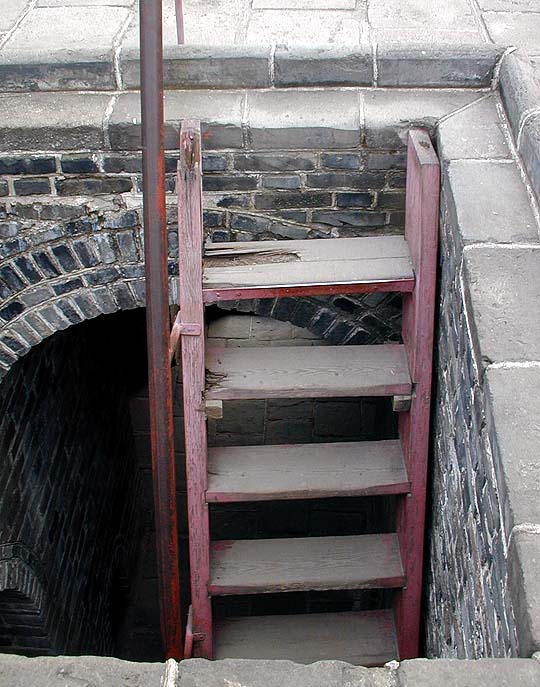
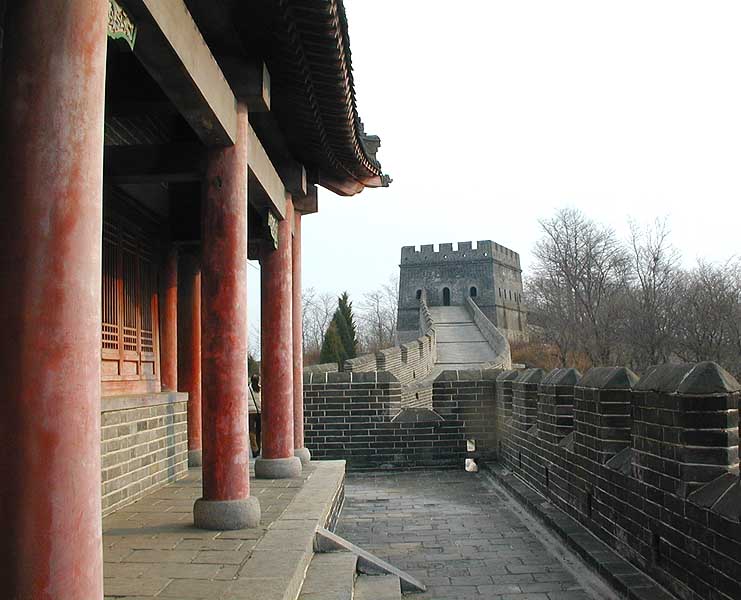
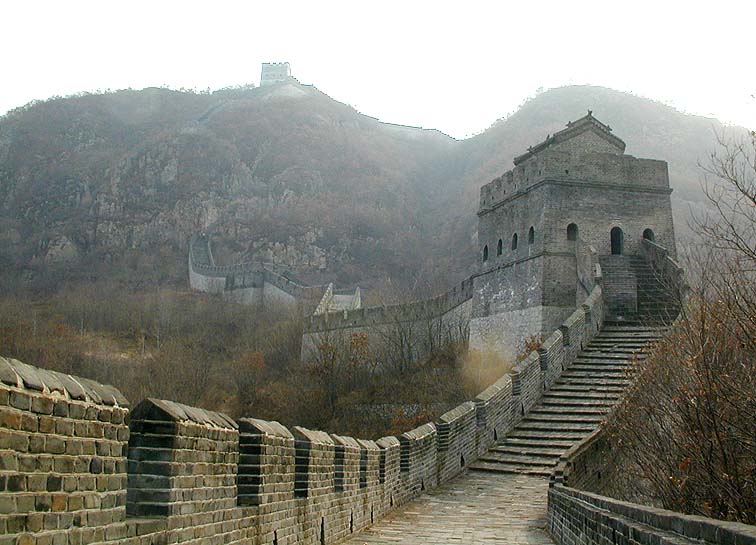
Admission to the tourist zone cost me another 30 Yuan; I passed on paying for admission to the Museum Commemorating the War to Resist American Aggression and Aid (North) Korea. When we arrived I paid my driver, he indicted that he’d wait for me. Would he? With the language barrier I was nervous. I had a train to Beijing to catch that evening and with the place deserted if he took off I'd be marooned. The Great Wall in this region is in great disrepair so if I worked for that government entity, the 2nd thing I’d do once I got that road paved is to spruce the place up a bit, put the missing tiles back into the footpaths and put in new ladders to replace the dangerously rotten wooden ones.

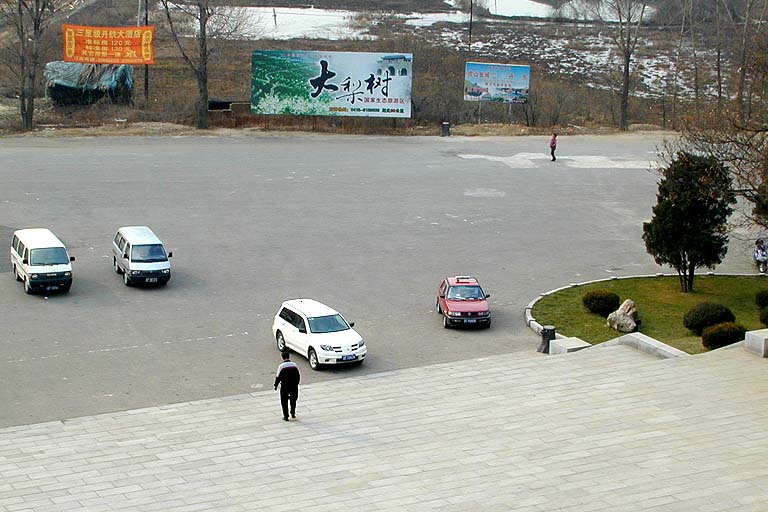
Above: my driver walks back to his red cab. The parking lot was almost empty OK, so the place needed some work. But this is the Great Wall of China! I looked around, it seemed that I had the whole place to myself. But I didn't want to let that cab out of my sight. But there was still plenty to see.


When I got back to the entrance my driver was still there, smoking a cigarette and listening to the radio. He looked at me and asked , “Choson?”, pronounced in a fast bark, Chow-sien. I already knew that the word Choson meant North Korea and thanks to the Internet I knew that the border in this area was just a small creek; perhaps he was offering to show it to me.

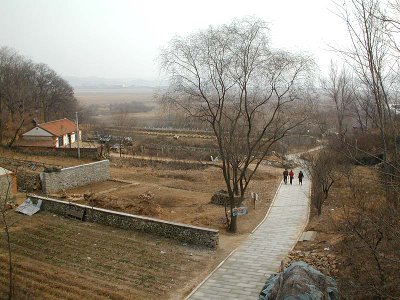
He took me to the creek that forms the border between China and the DPRK and pointed out 2 armed soldiers from the Korean People’s Army in the distance. He started to shout and wave at them. At first they ignored him but they soon started walking our way with their rifles slung over their shoulders. When they got closer a woman selling tourist nick-nacks from a cart indicated that I should buy a carton of cigarettes from her (around $6 US) and throw them across the creek. The soldiers asked who I was, the driver replied that I was an American. The woman indicated that now was the time for me to hurl the carton of smokes into North Korea. I hit the shore with the carton, the soldiers pretended not to notice. But when I lifted my camera up to my eye to get the shot they noticed that and protested loudly. When they walked away without the carton the woman who sold me the cigarettes gestured that it was alright to take a picture. I had read that the soldiers would come back for the cigarettes when there was no one around. So that’s 1/3 of the Axis of Evil. I didn’t see any actual evil on either my boat buzz of Sinuiju or my encounter with the KPA but perhaps the Kim family is keeping their reservoir of evil someplace else where I couldn’t see it.